Apple Becomes an AI Selloff Refuge After Cook’s 2,300% Rally


Bloomberg’s Ryan Vlastelica argues that Tim Cook’s 15-year tenure turned Apple from a roughly $350 billion company into a $4.6 trillion one, with shareholder returns driven less by blockbuster launches than by sustained execution and a larger high-margin services business. As John Ternus takes over, Vlastelica says Apple’s comparatively limited AI exposure has also made it a relative refuge when sentiment turns against AI-linked chipmakers and infrastructure spending.
Apple has become a relative refuge when the AI trade weakens
Ryan Vlastelica says the immediate market story around Apple is not Tim Cook’s handover of the chief executive role to John Ternus. Investors were not expecting a rocky transition, he says, and the stock had not been pulling back in response to Cook becoming executive chair.


Instead, Apple has developed what Vlastelica calls a “pronounced negative correlation” with the AI trade—particularly with semiconductor stocks and the Nasdaq 100. The logic is relative exposure. Apple is not investing in AI as aggressively as the hyperscalers, he says, and it has not benefited from AI enthusiasm in the same way chipmakers have.
That can make Apple a destination when confidence in AI begins to fade. When sentiment toward AI is strong, investors favor companies tied more directly to AI investment and chip demand; when it weakens, Vlastelica says, capital can rotate back into Apple.
If sentiment towards AI starts to sour a little bit, we see people in general rotate back into Apple and vice versa.
On the day discussed, chipmakers were weakening amid concern about AI’s broader outlook while Apple was outperforming. Bloomberg Tech’s intraday panel showed Apple at $324.27, up $7.42, or 2.35%.
This is a trading relationship, not Vlastelica’s explanation of how Cook built Apple’s value. His account distinguishes the company’s current relative position in AI-driven markets from the longer operational and financial changes that supported its 15-year run.
Cook’s record was built on sustained outperformance, not launch-day spectacle
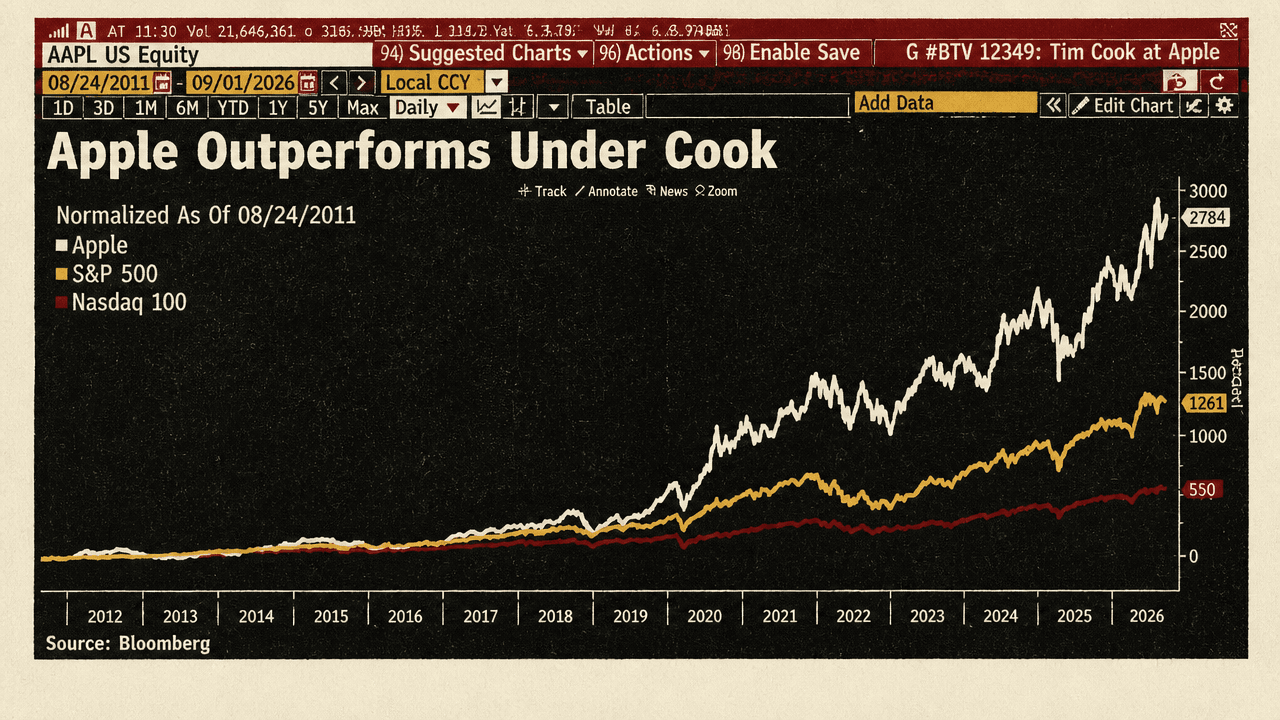
That longer record is unusually large. Ed Ludlow describes Cook’s tenure as a transformation from a company valued at roughly $350 billion when he became CEO in August 2011 to one valued at $4.6 trillion as Ternus took over. Apple shares rose almost 2,300% during that period, ahead of both the S&P 500 and Nasdaq 100.


Bloomberg’s normalized chart gives the benchmark comparison more precision. From August 24, 2011 through 2026, Apple gained 2,784%, versus 1,281% for the S&P 500 and 600% for the Nasdaq 100. The comparison separates Apple’s Cook-era performance from a general rise in equities or technology stocks: Apple outperformed both reference indexes.
Vlastelica says Cook is often considered less exciting than Steve Jobs, particularly because he was less associated with dramatic new-product introductions. That reputation can obscure the magnitude of Apple’s market performance under him.
Underneath Tim Cook, even though he has sort of the reputation for not being nearly as exciting as a Steve Jobs, the stock performed extremely well under him.
A Bank of America figure cited by Vlastelica puts the duration of that compounding in concrete terms: Apple added more than $30 million in market capitalization every hour for 15 years. The point is not a single product cycle or short-lived valuation expansion, but the scale of value accumulated throughout Cook’s tenure.
Services shifted the emphasis toward recurring revenue
Ryan Vlastelica attributes part of Cook’s market legacy to the expansion of Apple’s services business. Services added high-margin, recurring revenue to the company’s mix, shifting some of the emphasis away from the product-launch drama most closely associated with the Jobs era.
A real focus on building out the company’s services business, which is high margin, recurring revenue. So more of that, less of the exciting sort of new product introductions that people associate with the Steve Jobs era.
In Vlastelica’s account, that is the financial character of the Cook years: less defined by the expectation of a singular blockbuster introduction, and more by sustained accumulation and a larger recurring-revenue business. The current AI correlation is a separate matter—one that reflects how investors position Apple against more aggressively AI-exposed companies.