Anthropic Weighs Reserving 15% to 20% of IPO Shares for Retail Investors


Anthropic is considering reserving 15% to 20% of the shares in its planned IPO for retail investors, Bloomberg reports, with JPMorgan Chase tapped to lead the US offering. Bloomberg reporter Ryan Gould said the possible allocation could encompass a broad range of investors, but the report does not establish a final percentage or explain how shares would be distributed.
The 15%–20% figure is a possible allocation, not a settled plan
Anthropic is weighing setting aside 15% to 20% of the shares available in its planned IPO for retail investors, according to Bloomberg. The company has tapped JPMorgan Chase to lead the US retail offering. The allocation is under consideration; the report does not establish a final percentage, the rules for receiving shares or how many investors would qualify.
Bloomberg reporter Ryan Gould described the category as potentially broad. It could include high-net-worth individuals, private-banking clients and people trading through broker-dealers on platforms such as Robinhood. Gould called the range a “broad brush” estimate, not a settled account of eligibility. The report therefore points to a possible scale for retail participation without specifying how an individual investor could secure an allocation.


To illustrate the potential size, Gould used a $100 billion IPO as a hypothetical. At the top of the reported range, $20 billion of shares would go to retail investors. That figure is an illustration, not a reported fundraising target for Anthropic. Gould said the company might be thinking on a scale comparable to, though perhaps not as large as, a recent IPO he described as the biggest seen up to that point: SpaceX’s, which drew more than $100 billion in demand.
The comparison was about the scale of interest and the place of retail investors in a large offering, not a claim that Anthropic’s IPO would match SpaceX’s demand. Gould said a retail allocation of that size would be notable because it could give investors a “pure play” trade on AI models.
If Anthropic were to raise a hundred billion dollars in this deal, to think that 20 billion of that could go towards retail I think is kind of staggering.
The distribution plan divides US and international retail efforts
JPMorgan Chase would lead the US retail offering. Internationally, Citigroup—an underwriter on the deal, but not one of its top-line underwriters—would coordinate the retail component, according to Gould. The distinction matters: the reported plan assigns different banks to retail distribution in different markets, rather than describing a single global effort led by JPMorgan.
Gould said Anthropic’s prospectus identifies offerings in the United Kingdom, Australia and certain European Economic Area countries. He described international orders as a significant part of the effort, but the report did not quantify their expected size or explain how shares would be divided among markets.
Gould connected the retail plan to the scale of the prospective deal. Large IPOs, he said, are making retail participation increasingly important, and he cited SpaceX’s demand as context. That is his explanation for why the retail component merits attention; it does not establish how many shares Anthropic will ultimately reserve or how demand will compare.
The prospectus, Gould said, presents participation as being about “part of something bigger,” not just owning shares. That framing places retail investors within Anthropic’s description of the offering, alongside the practical question of distributing shares through US and international channels. It does not change the uncertainty around the allocation itself.
Growth, large customers and a reported loss sit side by side
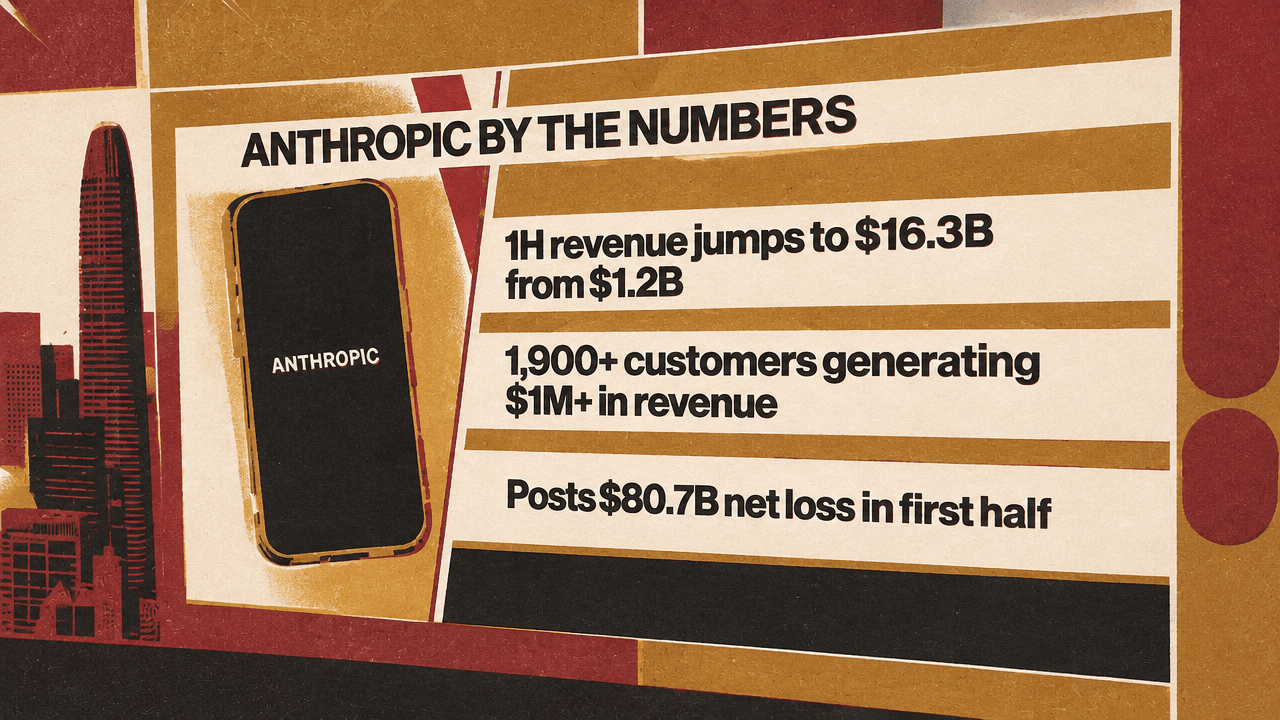
A Bloomberg graphic titled “Anthropic by the numbers” showed three first-half figures: revenue of $16.3 billion, compared with $1.2 billion; more than 1,900 customers generating over $1 million in revenue; and a net loss of $80.7 billion.
The revenue comparison is explicitly a first-half figure in the graphic, as is the reported net loss. The customer count adds another dimension: the display pairs the revenue comparison with the number of customers above a stated revenue threshold. Together, those figures offer business context for readers considering the company behind the proposed offering: the graphic presents revenue growth, a substantial base of high-revenue customers and a large reported loss at the same time.
The figures were shown alongside the IPO discussion, but neither Gould nor the graphic linked them to the possible retail allocation. They do not explain why the 15%–20% figure is under consideration, how shares would be distributed or whether the allocation will be finalized. The reported allocation and the business snapshot answer different questions: one concerns who might receive shares in the IPO; the other presents selected measures of Anthropic’s first-half business.