Air Force Autonomous Fighter Award Moves Anduril From Prototype to Production


Anduril CEO Brian Schimpf told Bloomberg Technology that the company’s new US Air Force production contract is a test of whether it can turn an autonomous fighter prototype into a manufactured operational aircraft at scale. He argued that the same constraint now runs across defense: weapons, aircraft, space systems, and allied stockpiles are less limited by technical ambition than by whether the US and its partners can produce enough capability quickly enough for modern conflict.
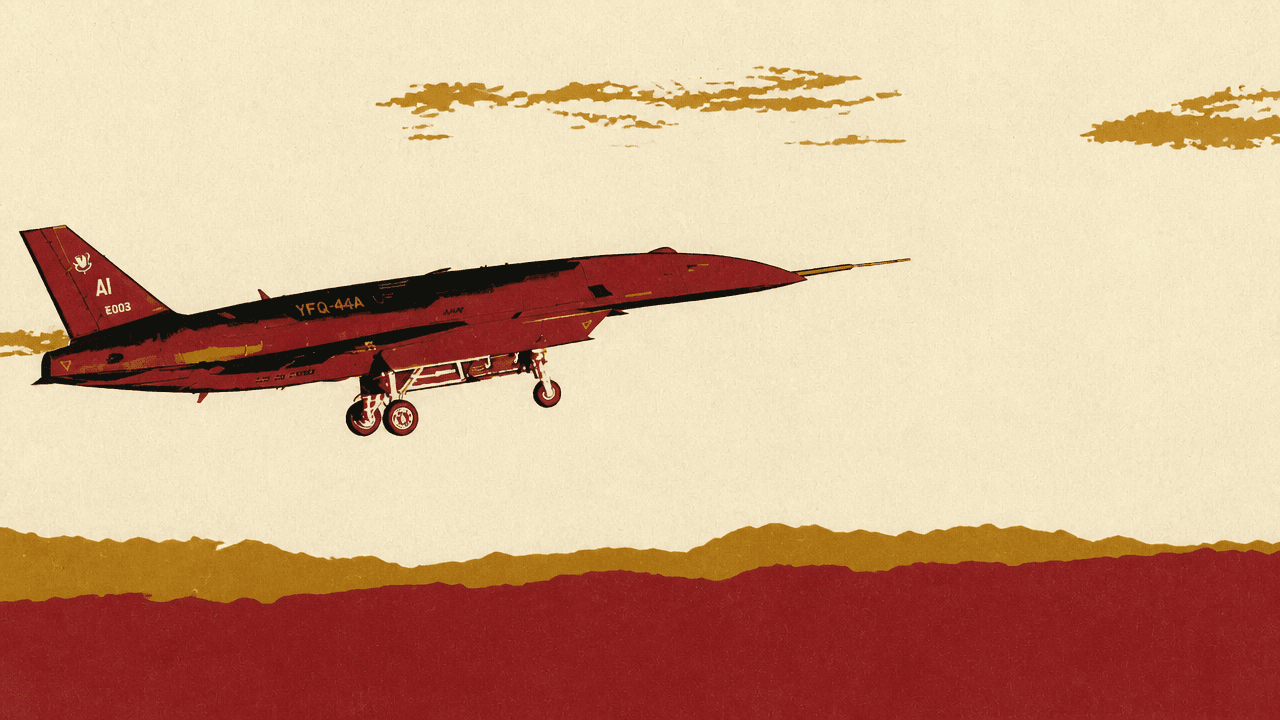
The Air Force award tests whether Anduril can turn prototype tempo into scaled production
The Air Force production contract matters, in Brian Schimpf’s telling, because it moves Anduril’s autonomous “loyal wingman” fighter jet from repeated flight validation into the harder phase of operational manufacturing. The aircraft has been flying multiple times a day, he said; the award confirms that the program now shifts from prototype technology into a production aircraft. The broader Pentagon ambition, as Bloomberg framed it, is a fleet of up to 1,000 autonomous combat jets.


That shift is the strategic consequence Schimpf emphasized. Anduril has already begun producing the aircraft at Arsenal 1, its facility in Ohio, and expects to “really start to ramp” next year. He acknowledged the risk directly: the defense industry has struggled to increase production fast enough to meet demand around the world. Anduril’s claim is that it has invested ahead of that bottleneck and is “hitting every ramp” it has promised.
This is really about taking it from prototype technology, which we've been validating, we've been flying multiple times a day into now an operational capability.
The pace of the program is part of the argument. Schimpf credited the Air Force with moving at what he called “the fastest fighter jet programs since the 1950s,” and said the award shows that the government can move quickly when it chooses to and that industry can respond at that speed.
The management problem underneath the announcements is whether Anduril can keep assigning people, teams, and capital across new contracts, new technology, and programs already in ramp. Schimpf pushed back on resource allocation as the main constraint. He said demand is “through the roof across the board,” including weapons and aircraft programs, and that Anduril has doubled headcount every year while continuing to staff programs successfully. The challenge, as he described it, is execution speed: “running through it as fast as we can.”
The business implication is longer-cycle rather than immediate. Programs like this, Schimpf said, create a base of growth for roughly the next five years and support production and delivery over the next decade. His account was that stacking multiple large programs into future years gives Anduril a durable foundation for compounding growth.
Weapons demand is exposing the production shortfall
The same production-capacity problem runs through Schimpf’s view of weapons. He said the United States has “amazing weapons,” but called its inability to produce them at scale, supply allies quickly, and avoid long delivery delays “a major strategic issue” for the US and its partners. Demand for next-generation weapons that can be produced at scale has increased sharply, he said, out of the conflict in Iran.
The lesson Schimpf drew from that conflict was about consumption rates. In the first 30 days, he said, the number of strikes and munitions consumed was “something around 10 times” what was consumed in the entirety of the Gulf War. He added that the US was shooting “nearly a decade of Tomahawk production in a week.”
Schimpf connected that pattern to other recent conflicts, especially Ukraine, where he said munitions consumption has been “staggering.” The strategic question, in his view, is no longer only whether the US has sophisticated weapons. It is whether it has the inventory, stockpiles, and producibility needed for modern conflict.
That also changes the kinds of systems he thinks the US and its allies need. Schimpf argued that many scenarios can be addressed with capabilities that are lower-priced and more fit for purpose than the most advanced weapons. The point is not only cost efficiency. It is deterrence: adversaries need to believe the US and its allies have the resilience to sustain the uses they are realistically likely to require.
He described that as the “biggest shift” he has seen from the Iran conflict: an acceleration toward more producible capabilities. Anduril, he said, has “maybe a half dozen or more” programs that have initiated from that demand.
Space competition adds another demand for resilient capacity
Ed Ludlow raised Anduril’s subterranean work as a subject viewers frequently ask about, but Schimpf’s answer moved first to space. He described an “immense amount of work” there and called space a next-generation warfighting domain.


His emphasis was that space competition is already active, which makes it part of the same deterrence problem rather than a speculative technology category. Schimpf cited Space Force discussion of adversarial activity by Russia and China, including regular maneuvering in orbit and threats to US and allied satellites. He also referred to an open-source report of Russia maneuvering against a commercial satellite used to provide intelligence to Ukraine.
Schimpf said the United States needs leadership in space to deter adversarial activity that, in his words, is happening “every day.” Unlike the weapons discussion, he did not give program counts, production details, or specific manufacturing plans for space. He treated it as a growth area where the objective is to make US and allied capability credible enough to deter hostile activity.
Allied production is treated as part of the stockpile strategy
The question of where Anduril builds next is tied, in Schimpf’s account, to how allies want to control weapons supply. Brian Schimpf has said Arsenal 2 could be built outside the United States; when Australia and Taiwan were raised as possible locations, he did not name a site. He instead argued that allies will increasingly want more control over the production and supply of weapons.
That desire, he said, is “correct.” In Schimpf’s view, production capacity among allied nations is itself a contribution to collective defense. He said the administration wants allies prepared to contribute, and that allied production feeding allied stockpiles is “hugely advantageous.”
Anduril already has a factory operating in Sydney, Australia, making Ghost Shark, Schimpf said. Beyond that, he described the location and structure of future production as a case-by-case process: what a country needs, how it wants Anduril to work with local partners, and how local industry fits into the effort.
Schimpf’s stated frame is deterrence. Allied manufacturing, as he put it, is one dimension of giving allied nations more production capacity and more ability to contribute to shared stockpiles.
We think of allied production as a critical dimension of providing that deterrence that we're here to do.