Anduril Raises $5 Billion to Scale High-Volume Weapons Production



Anduril CEO Brian Schimpf told Bloomberg that the company’s $5bn funding round, valuing it at $61bn, is intended to accelerate production rather than complete a single factory project. He argued that demand in defense is shifting toward high-volume, lower-cost systems that can be manufactured quickly, making production capacity, replenishment and private capital central to Anduril’s strategy.
Anduril’s new capital is for production, not a finished factory
Brian Schimpf described Anduril’s $5 billion financing as fuel for a production phase rather than a discrete project budget. Schimpf said “production is the name of the game,” with the “vast majority” of capital going into factory scaling, the production workforce, inventory, and the mechanics of ramping output.


Bloomberg’s on-screen summary framed the financing as a $5 billion round led by Thrive Capital and Andreessen Horowitz, valuing Anduril at $61 billion, with the company planning to invest “aggressively” in manufacturing and infrastructure. The same graphic said Anduril doubled revenue to $2.2 billion in 2025.
The operational reason for the raise is demand rising faster than Anduril’s production base. Schimpf put production revenue growth at “something like 250%” year over year. When Ed Ludlow pressed whether the $5 billion is sufficient to finish Arsenal-1 and begin the production ramp, Schimpf rejected the premise that Arsenal-1 is a near-term finish line.


Anduril, he said, was already ramping production with existing cash. The new round is meant to “continue to fuel that growth.” He does not expect Arsenal-1 to be “done anytime soon,” because demand and the required scale are expected to keep rising for several years. He called that “a good problem to have” and pointed to private markets as a mechanism that lets the company fund aggressive industrial expansion quickly.
Demand is being defined by volume, replenishment, and price
Brian Schimpf gave a more specific account of demand than a general claim that defense technology is in favor. Anduril is nine years old, he noted, and still addresses a “quite small” fraction of the market even as geopolitical conflict increases focus on defense technology and much spending still flows to prime contractors.
Schimpf said demand is concentrated in counter-drone systems, air and missile defense, electronic warfare, surface-to-air missile systems, and low-cost cruise missiles. He tied that demand to current conflicts, where the volume of munitions and the need to defend against them have become central operational problems.
His most concrete example was Barracuda, Anduril’s low-cost cruise missile. Schimpf said a multi-year procurement had been announced and that the department is buying “thousands a year.” Anduril is ramping Barracuda “at just an unprecedented pace,” he said, because of what he described as a critical munitions shortage and the need to sustain conflicts while maintaining deterrence.
That same operating thesis shaped his answer on Golden Dome, the administration missile-defense project that Caroline Hyde framed by citing Congressional Budget Office forecasts suggesting a potential cost of up to $1.2 trillion. Schimpf argued that large cost estimates reflect historical approaches built around “extremely expensive and extremely exquisite” systems costing $10 million, $20 million, or $30 million per shot. Commercial technologies, proven capabilities, and a different systems approach, he argued, can move the project to “a much more efficient place.”


We shot something like a decade of Tomahawk production in 72 hours.
The Tomahawk example was Schimpf’s shorthand for the replenishment constraint. In his telling, affordability is only one side of the problem. The more basic question is whether the country can manufacture enough systems to sustain use. He did not give a replacement price for Golden Dome, but framed national-scale execution as achievable on a more aggressive timeline and at a more efficient price than historical expectations if the approach departs from prior defense-procurement patterns.
The roadmap is broader than a single weapons category
The company’s product process, as Brian Schimpf described it, starts with shifts in technology and warfare: identify capabilities likely to matter over the next five to ten years, then invest before the market is fully visible. He did not describe specific subterranean weapons systems, despite Ed Ludlow raising Palmer Luckey’s claim that half of Anduril’s products are not widely known and asking about the next phase beyond Arsenal-1.
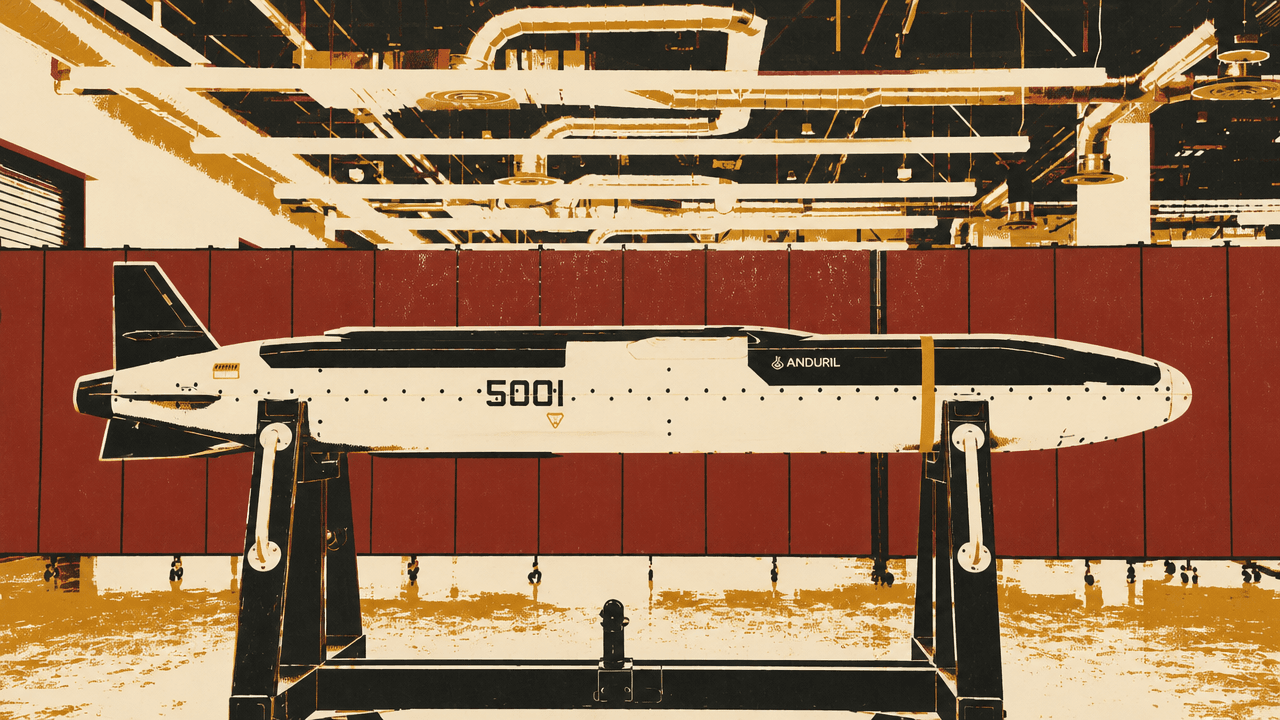
Bloomberg showed Anduril-sourced footage while this point was being discussed, including a drone launching vertically from a tripod, a software interface with a “Confirm Execute” button over a map, underwater footage of a submarine-like vehicle, the Fury autonomous aircraft, missile-like hardware marked “5001,” and drones operating over desert or field environments. The visuals supported the breadth Schimpf described: air, missile, software-command, maritime, and autonomous systems rather than a single product line.
Schimpf said Anduril is expanding its air and missile defense portfolio and entering new domains. He characterized Luckey as someone “always experimenting with the latest and greatest technologies” and looking for what can be done that others thought impossible. But he returned to a disciplined frame: what dominant technologies will matter over the next 10 or 20 years?
His answer was shaped by Iran and Ukraine. The “sheer volume of munitions” being exchanged, and the need to defend against that volume, are capabilities he said any future defense posture will need to solve. That leads Anduril toward strike capabilities, intelligent targeting, and defensive systems that can handle mass rather than only exquisite one-off assets.
Private capital has weakened the case for rushing to an IPO
For Brian Schimpf, the traditional reasons to take Anduril public have become less compelling. The company’s objective, he said, is to become “one of the most impactful businesses in the world,” with a focus on U.S. and allied warfighters, deterrence, and scale. An IPO is a tool only if it advances that objective.
Private capital markets, in Schimpf’s view, have grown large enough that Anduril does not need public-market access for funding. He noted that a raise of Anduril’s size would have been near the upper end of private-market capital raises a few years ago, but is now “a fraction of an AI fund raise.”
Nor, he argued, does Anduril need to go public for liquidity. Early investors and employees can receive liquidity through other private-market mechanisms. That leaves the question of business readiness. Schimpf said the right time to go public would be when Anduril has shown that its model works at scale and that its economics can support a high-growth, high-margin business.
Until then, “we’re not in any rush” and “we don’t have any pressure to do it.”
Private shares create a control problem as demand broadens
Retail demand for exposure to private companies creates a control problem for Anduril’s cap table. Bloomberg showed a graphic quoting Anthropic’s warning on unapproved stock sales: “Any sale or transfer of Anthropic stock, or any interest in Anthropic stock, that has not been approved by our Board of Directors is void and will not be recognized on our books and records.”
Brian Schimpf said Anduril tries to control its cap table tightly: the company wants to know who its investors are, ensure they are aligned for the long term, and keep out parties there for the wrong reasons. He described “very bad actors” trying to sell things that are “just not allowed,” and treated the issue as broader than Anduril.
Schimpf declined to name secondary-market providers he takes issue with. He distinguished between platforms and individual brokers, saying most secondary-market brokerages or listing venues are not inherently the problem. The issue, in his view, is brokers misrepresenting what they have access to. That conduct, he said, is harmful in public markets and private markets alike, and affects many high-interest private companies.
Taiwan is treated as a deterrence problem, not a desired conflict
On the president’s China visit, Taiwan, and the often-discussed 2027 threat window, Brian Schimpf answered first with diplomacy. “Diplomacy is good,” he said. “We are in the deterrence business. We do not want there to be conflict.”
Anduril is providing technology to Taiwan and supporting it where possible because, in Schimpf’s view, Taiwan needs the right capabilities and deterrence. He treated the 2027 window as a period of elevated risk rather than a specific invasion date. He said he does not think anyone believes “January 1, 2027” marks the beginning of an invasion. Rather, the date represents a period when the PRC has a more established military capability and the U.S. and Taiwan may be at a relative disadvantage compared with other points in time.
Schimpf placed that risk against a broader backdrop: Iran, Ukraine, and other global hot spots are already creating stress on the U.S. military. His stated hope for the summit was a diplomatic outcome that preserves a status quo he described as “working reasonably well.”