Alphabet Raises CapEx to $205 Billion as AI Compute Demand Outstrips Supply


Alphabet’s decision to raise the top end of its annual capital-expenditure plan to $205 billion reflects a need to add AI compute capacity as demand outstrips supply, rather than weakness in its core businesses, Goldman Sachs analyst Eric Sheridan argues. He says the resulting pressure on free cash flow has unsettled investors, but stable Search, stronger Cloud growth and demand for a broader mix of efficient AI models support the long-term case. The remaining test is whether Alphabet can pair that infrastructure spending with a return to frontier model performance.
Alphabet is choosing capacity over near-term cash flow
Eric Sheridan sees Alphabet’s raised capital-expenditure plan as a response to constrained AI compute capacity, not evidence that its core businesses have weakened. Alphabet lifted the top end of its annual CapEx outlook to $205 billion, while second-quarter capital expenditure reached $44.9 billion.


The spending coincided with Alphabet’s first swing to negative free cash flow as a public company. Sheridan calls the earnings report a mixture of “signals versus noise.” The longer-term signals, in his view, are a stable Search business, continuing momentum at YouTube, and Google Cloud revenue that is reaccelerating and could grow at an outsized rate over much of the next one to two years.
| Metric | Second-quarter actual | Versus estimate shown |
|---|---|---|
| Diluted EPS | $9.11 | +213.7% |
| Revenue | $119.8B | +2.4% |
| Capital expenditure | $44.9B | +1.75% |
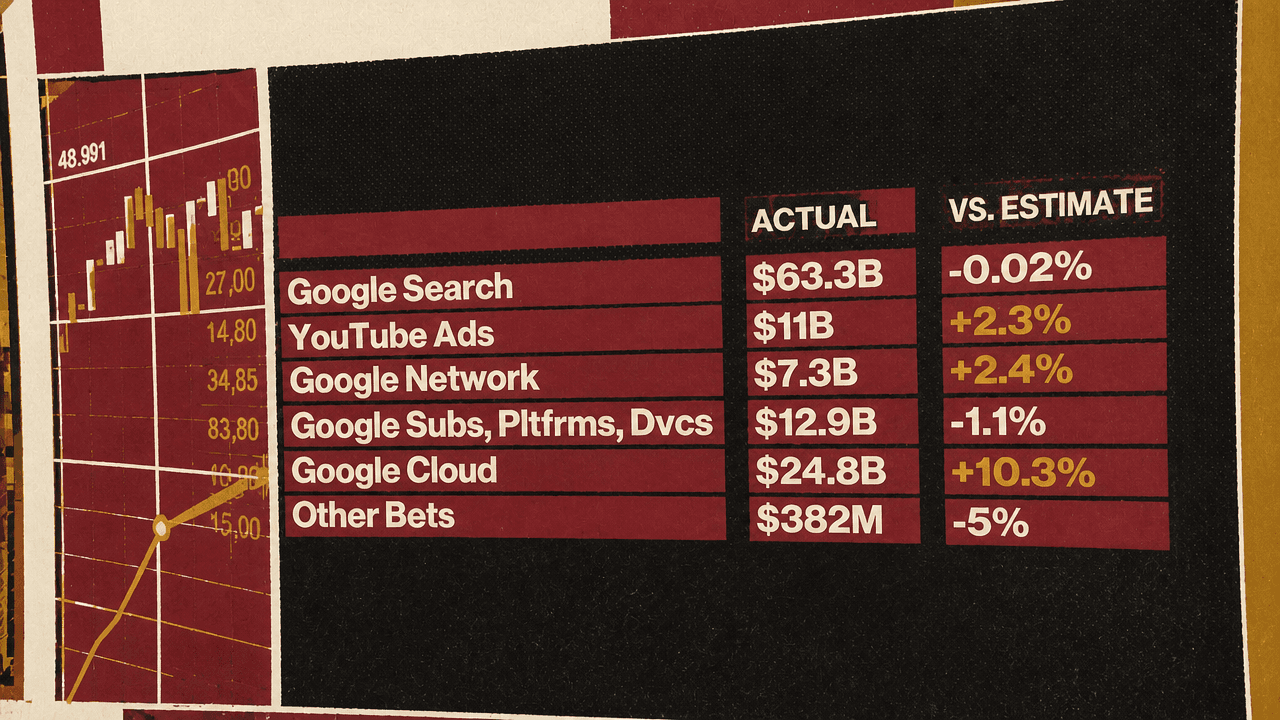
| Google Cloud revenue | $24.8B | +10.3% |
| YouTube advertising revenue | $11B | +2.3% |
Sheridan says Alphabet raised CapEx and secured third-party compute to close the gap between demand for compute and available supply. The company did not want to slow growth or disappoint external clients. Those decisions also affect operating expenses, placing immediate pressure on cash generation.
The market reaction reflected that tension. A Bloomberg Tech graphic showed Alphabet shares down 6.4%, erasing $265 billion in market value, alongside the negative-free-cash-flow result. Sheridan acknowledges that investors are not rewarding companies that over-index to investment while under-indexing to short-term returns. But he argues that Alphabet is making the appropriate long-term choice against the AI opportunity it expects over the next several years.
Spending heavily is not the same as leading the model frontier
Ed Ludlow posed the simple question behind the results: is Google doing well at AI? Sheridan says it remains an AI winner, although the market has pulled back from that assessment. Goldman Sachs retains a buy rating on Alphabet and a $435 price target, lowered from $440.


The qualification is model performance. Sheridan says delays around Gemini 3.5 Pro and the absence of a foundational model that sits directly at the frontier of performance and benchmarking have “taken a little bit of the shine” off the AI-winner theme. He says Sundar Pichai indicated that Alphabet may have to wait for Gemini 4 to return to that frontier.
Sheridan does not treat a short-term performance gap as proof that Alphabet lacks the resources to compete. He points to its access to chips and data, and to its ability to train models, arguing that Alphabet is as well positioned as anyone. But major training runs can create intervals in which model performance lags, even for a company with those advantages.
Investors, he says, are applying a combined test: a company spending at this scale must show both investment in capacity and frontier-level model performance. Alphabet may need a few months before it can offer the latter.
Investors want to see companies spending this amount of money, then they want them at the frontier of model performance.
The enterprise case rests on optimizing, not maximizing, token use
Eric Sheridan argues that AI demand will not be defined simply by customers consuming the maximum possible number of tokens. The market is moving from “token maxing” to token optimization: using a broader mix of models according to speed, efficiency, and cost.
That means benchmark leadership is not the only relevant measure of competitiveness. Sheridan points to Google’s Flash models, which emphasize speed and efficiency, as products that can keep Alphabet competitive for incremental workloads even if another model has the stronger general frontier profile.
For enterprise customers, Sheridan says, the proposition is not buying tokens from a single model regardless of price. Companies such as Alphabet can offer a wider range of tokens from a wider range of models and help customers optimize their spending. He expects Amazon to make a similar argument when it reports.
Cloud revenue is the commercial indicator Sheridan identifies for whether enterprise AI demand is translating into usage. Alphabet’s $24.8 billion second-quarter Cloud revenue, 10.3% above the estimate displayed by Bloomberg, is therefore central to his case that expanding infrastructure and a broader model portfolio are finding enterprise demand.
The economic mechanism, Sheridan argues, is deflation. Every technology and computing shift he has covered has paired unit growth with lower costs, because lower prices encourage adoption. AI, he says, should be no different: driving utility and token growth requires deflation.