Inference Demand Keeps Hyperscaler AI Spending Justified

Lazard Asset Management portfolio manager Celine Woo argues that hyperscalers’ AI spending remains justified because cloud-infrastructure demand still exceeds supply and inference workloads are becoming a larger source of growth. Woo says agentic AI is adding to demand for semiconductors and capacity, while backlog, customer visibility and long-term supply agreements give companies grounds to commit capital before the associated revenue fully appears. Her case rests on whether suppliers can expand quickly enough to prevent components such as chips and memory from becoming a constraint.
Inference demand is giving AI spending a nearer-term economic case
? celine-woo says the case for continued AI infrastructure spending rests on a changing workload mix: inference is becoming a larger driver of demand, and agentic AI is increasing the need for cloud capacity and semiconductors.
Ed Ludlow framed inference as the new driver of growth while training workloads remain in place. Woo agreed that companies are reporting a larger share of inference workloads, particularly as agentic AI expands.


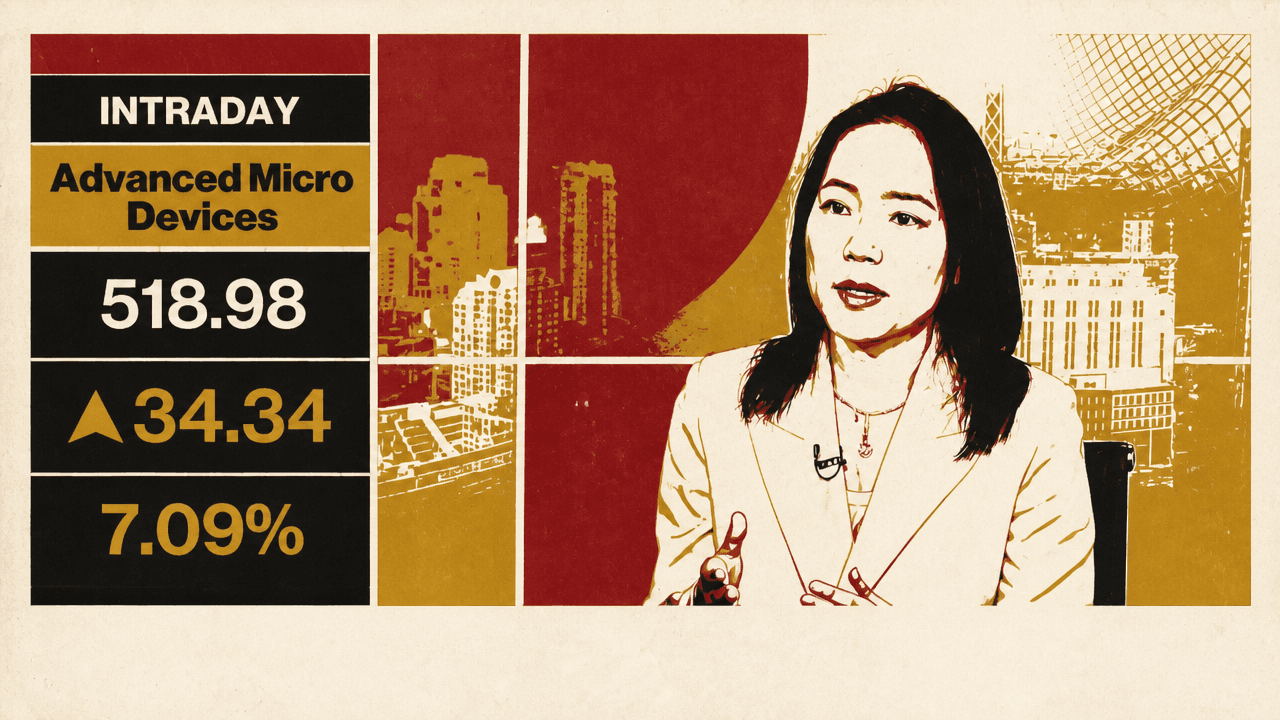
That shift broadens the opportunity within the hardware supply chain. Woo said AMD’s CPUs could benefit as a core driver of inference demand, alongside the wider semiconductor ecosystem serving hyperscaler buildouts. Demand for cloud infrastructure still exceeds available supply, she said, leaving demand that the relevant hardware and semiconductor chain cannot yet fully meet.
Woo said Amazon, Alphabet, and Microsoft each reflected this pattern. Together, she said, the three companies delivered a combined 50% growth rate in the quarter—double the rate seen five quarters earlier. She treated that acceleration as validation of AI returns on investment and as support for continued spending, because the companies have extended backlog and visibility into customer demand.
Microsoft and Amazon stood out to Woo relative to expectations, though she described all three companies’ results as better than expected. Large AI commitments must be made upfront, she said, but the resulting revenue is beginning to show up in their core businesses.
I think people have to be comfortable and understand that by nature, this large spending commitment has to be taking place upfront, but over time, you are going to see the tangible numbers flowing through their core businesses.
Visible demand turns spending into a supply-chain coordination problem
? celine-woo pointed to extended backlog and customer visibility as the basis for committing capital before all of the resulting revenue appears. In her view, hyperscalers are not merely betting that AI demand will materialize; they can already see demand extending ahead.
Demand still exceeds available cloud capacity and the components required to build it, Woo said. That favors the semiconductor value chain, but it also makes execution a constraint. Chips, memory, and other necessary components need to arrive in time; otherwise, demand goes unserved and growth can taper.
The result is a coordination problem as much as an investment decision. Hyperscalers must build capacity against demand they can see, while suppliers expand quickly enough to prevent a shortage in a required component. Woo described the supply chain’s work to make that happen as underappreciated.
The displayed holdings of Lazard’s Next Gen Technology ETF, TEKY, place the hyperscalers and suppliers central to this buildout among its largest positions: Alphabet at 5.7%, Nvidia at 5.4%, Amazon at 4.6%, Broadcom at 3.8%, TSMC at 3.7%, and AMD at 3.3%.
| Company | TEKY net fund holding |
|---|---|
| Alphabet | 5.7% |
| Nvidia | 5.4% |
| Amazon | 4.6% |
| Broadcom | 3.8% |
| TSMC | 3.7% |
| AMD | 3.3% |
Long-term memory agreements signal demand beyond the next quarter
Ed Ludlow said five-year memory commitments were historically unusual. ? celine-woo read them as evidence of durable customer visibility and preemptive efforts to keep supply and demand in balance.
For Woo, long-term agreements in memory are a concrete response to the risk that capacity becomes the limiting factor. They allow customers and suppliers to plan around a long trajectory of demand and growth, rather than treating capacity as a short-term procurement issue.
I don't think they're spending money blindly.
The agreements do not remove the underlying constraint. They show customers trying to ensure that it does not restrict growth. What Woo described as unusual is not only the scale of AI demand, but the willingness to secure supply around a demand outlook extending well beyond a single quarter.
Upstream capacity plans rest on the same demand visibility
? celine-woo said demand visibility “is actually coming from the upstream.” She singled out TSMC, which she called the world’s largest foundry, as a company with especially strong visibility into customer requirements.
Woo pointed to TSMC’s commitment of an additional $100 billion in capital expenditure to expand in Arizona. Together with hyperscaler spending plans, she sees that commitment as evidence that companies can see demand stretching as far as five years and are building capacity against it now.
Foundry capacity, memory supply, and hyperscaler infrastructure spending therefore need to be planned as parts of the same system. Companies are spending today because they see demand ahead, while memory producers and other suppliers need to expand in step so capacity is available when workloads require it.
The central question, in Woo’s account, is not simply whether AI capital expenditure is too large. It is whether the supply chain can provide every needed component quickly enough to turn unusually strong demand visibility into sustained growth.