Netflix’s Ad Tier Adds a Flexible Lever as Revenue Growth Slows

Netflix’s slowing revenue growth and difficulty sustaining audience engagement leave it looking for ways to broaden its offer, Phillips Securities analyst Helena Wang argues. Advertising can give the company flexibility to tailor subscriptions to different markets, while sports and other partnerships can expand its content mix; the test, she says, is whether those additions keep viewers coming back between major hits.
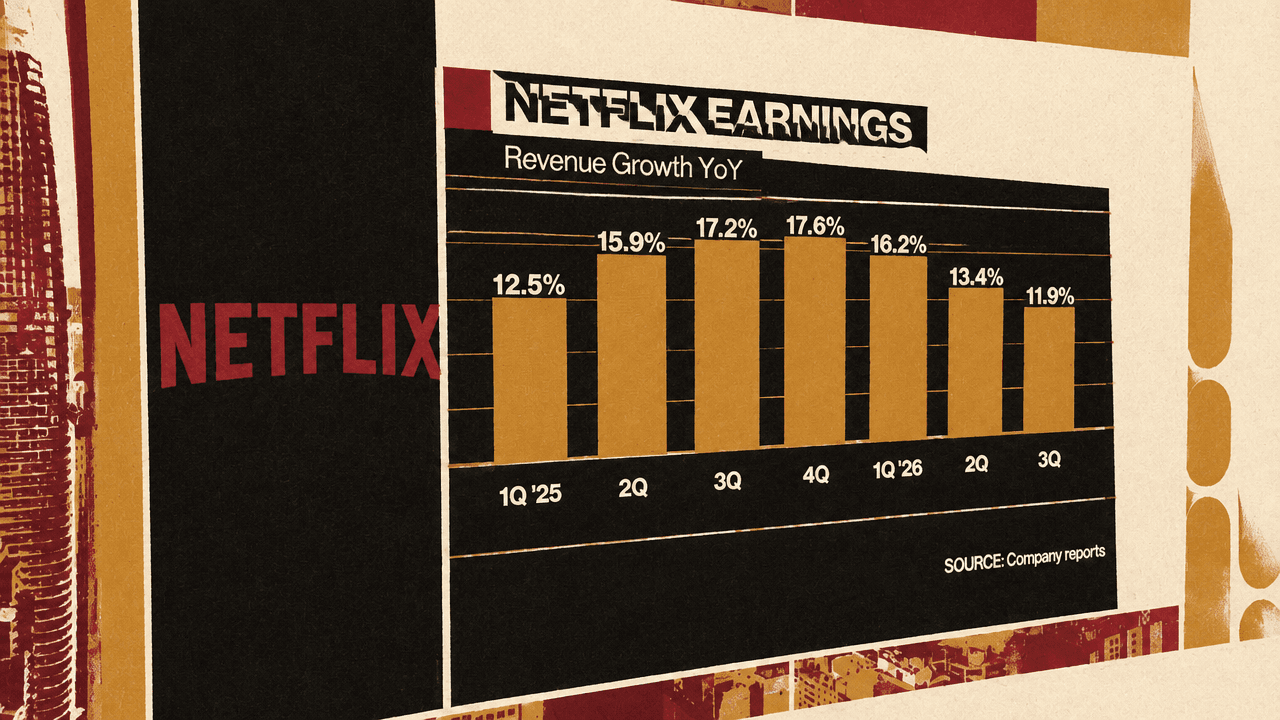
Growth is slowing, even as revenue continues to rise
Netflix’s concern is not that revenue is falling, but that its growth is decelerating. The figures shown on screen put year-over-year revenue growth at 17.6% in the fourth quarter of 2023 and 11.9% in the third quarter of 2024. Helena Wang said the company’s shares were down 28% year to date, largely because of relatively soft guidance the prior quarter. She had hoped stronger fourth-quarter guidance would restore confidence; instead, she expected fourth-quarter revenue growth to remain soft. Full-year guidance was in line, she said, but offered little upside to excite investors.
Wang described the pattern as “four quarters decreased in a row,” referring to the pace of revenue growth. The quarterly series shows growth rising from 12.5% in the first quarter of 2023 to 17.6% in the fourth, then easing through the first three quarters of 2024.
| Quarter | Revenue growth year over year |
|---|---|
| 1Q 2023 | 12.5% |
| 2Q 2023 | 15.9% |
| 3Q 2023 | 17.2% |
| 4Q 2023 | 17.6% |
| 1Q 2024 | 16.2% |
| 2Q 2024 | 13.4% |
| 3Q 2024 | 11.9% |
Advertising adds a market-by-market lever, despite rollout delays
Advertising is one possible growth lever, though the rollout has not met the company’s original target. Ed Ludlow noted that Netflix had attributed part of a sales shortfall to advertising, at $300 million less than expected. Wang said Netflix had doubled advertising revenue in the prior year and had initially aimed to double it again, supported by the rollout of its advertising platform. The company then lowered its guidance by about 10% because of delays in that rollout.


Wang called the revision disappointing, particularly given the high expectations. She also put the change in context: she said advertising was still growing about 80% year over year.
Advertising gives Netflix the extra lever to pull.
For Wang, the value of advertising is not limited to its revenue growth. Netflix operates across markets with different levels of penetration and price sensitivity. An ad-supported tier gives the company added flexibility to tailor its subscription offering to those conditions. She said Netflix planned to introduce the tier in another 15 countries the following year, providing an additional runway for growth.
More formats broaden the offer, but engagement remains the test
Wang said Netflix’s management changes showed the company was aware of the challenges it faced. She described the content problem as twofold: Netflix needs to produce blockbuster titles consistently enough to cut through an increasingly crowded market, and it needs to sustain audience interest when a major hit arrives. That means keeping viewers engaged and bringing them back for the next season rather than losing them to competing platforms in between.
The company is pursuing several ways to broaden its offer. Wang pointed to live sports, a partnership with Disney to bring the Ice Age films to Netflix, and efforts to partner with TF1 in France. She said Netflix’s global distribution network makes these arrangements attractive to partners. In her view, the initiatives complement rather than contradict one another: Netflix wants to offer entertainment across formats and become both the first platform customers turn to and the last subscription they consider canceling.
These additions address the breadth of content available on the service, but Wang identified engagement as the main problem Netflix still needed to improve. Live sports and partnerships are part of the effort to offer more kinds of entertainment; the challenge she described is turning that range into sustained audience attention between major hits and their next seasons.
The buy case rests on strengths alongside long-term questions
Wang’s stock view was positive but qualified. Phillips Securities maintained its buy recommendation, and she said the lower share price made Netflix a good entry point. At the same time, she said she had substantial questions about the company’s long-term prospects. Her reasons for remaining positive were its margins, pricing power and advertising potential.