Plug-In Solar Gives Households a Cheap Way to Offset Rising Power Bills


Bloomberg’s report argues that plug-in solar offers US households a relatively cheap way to make some of their own electricity and gain limited control over rising bills—not a way to power a home or escape the grid. A panel costing a few hundred dollars can offset some steady household demand, but the savings are modest and the systems are too small to make a major dent in utility revenue. Germany’s million-plus registered systems show how adoption can grow when the panels are treated as ordinary household equipment; in the US, 11 states had passed laws allowing them by October 2026.
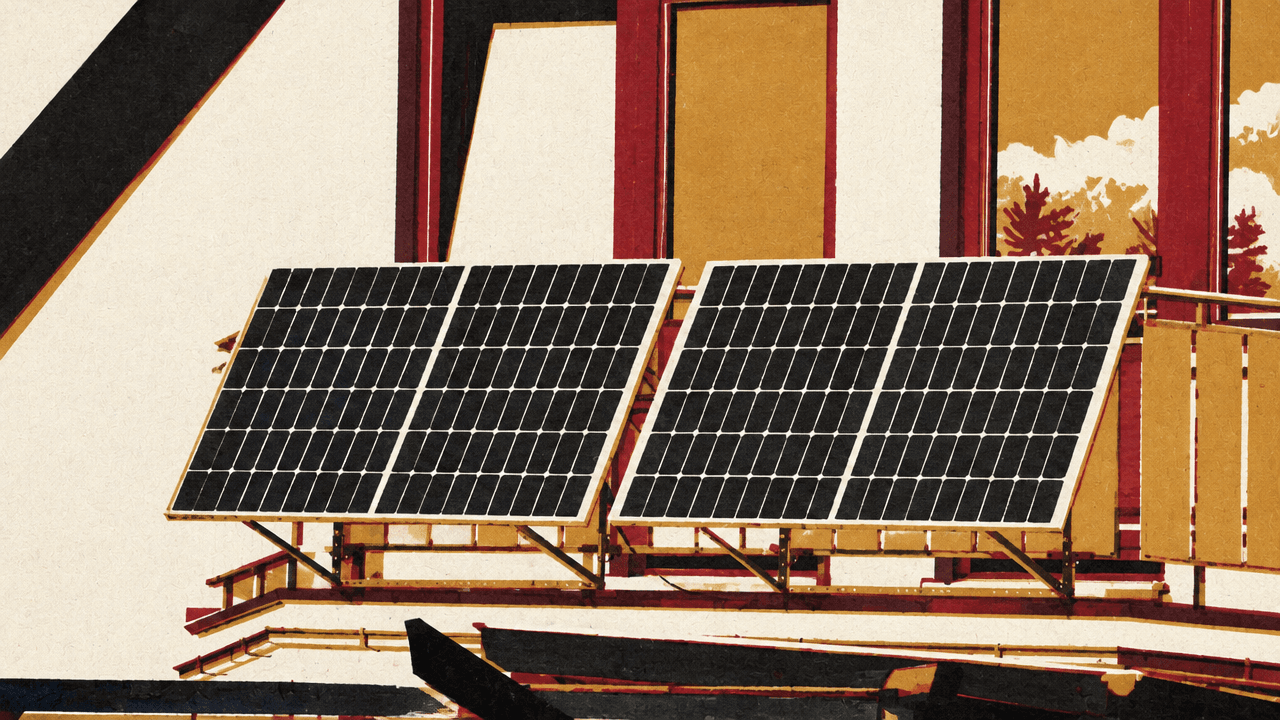
A small panel targets the part of the bill households can influence
For Chris and Karen Brown, the case for plug-in solar begins with a monthly bill that separates electricity from the cost of getting it to their Connecticut home. Karen Brown’s latest bill showed $235 for supply, $94 for transmission and $166 for local delivery. She noted that transmission and delivery together far exceeded the cost of the electricity they used.
US residential electricity prices rose 32% between 2020 and 2025. In California, rates rose 59% between 2020 and 2023. Bloomberg reporter Todd Woody said increases vary by state and utility, with inflation, transmission and labor costs among the factors. In some areas, he added, new data centers are another source of pressure.


The delivery charges reflect a system in which a local monopoly controls the wires and state regulators set prices. Utilities recover infrastructure-building costs over time and earn a regulated return on that investment. Investor-owned utilities spent a record $204 billion on construction in 2025; much of that spending is needed because the grid is old and overloaded. But customers have little say over that growing part of their bills.
That is the opening plug-in solar occupies: not a way to avoid the grid, but a way to make a limited amount of electricity at home. The Browns’ kit cost about $400. Karen said rising rates made them feel they had little choice.
The savings are modest; the entry price is the point
Rooftop solar can power much of a home and may let owners sell excess electricity back to the grid. But US rooftop systems can cost around $30,000, and high permitting, labor and installation costs help explain the price. Woody put US installation costs at two to three times those in Australia or Europe, citing high and complicated permitting costs. The comparison shown put residential rooftop solar at $2.53 per watt in the US, against $1.69 in Germany and $0.82 in Australia.
Plug-in systems cost far less: roughly $300 at the low end and $2,000 or more at the high end. A single panel can cover some of the steady background demand from appliances such as a refrigerator, Wi-Fi equipment and a television on standby. It cannot run most of a house, and users cannot sell excess power to the grid; the electricity is for their own home.
The hardware works because a microinverter converts the panel’s direct current into the alternating current used in household outlets, allowing its output to blend with power drawn from the grid. Safety depends in part on limiting output so a panel cannot overload a circuit. Germany settled on a maximum of 800 watts; most US states with plug-in solar laws set a 1,200-watt limit. Further safety rules remain unsettled. UL Solutions was still finalizing a standard, and no complete kit had yet been certified. Some proposed requirements could mean a special outlet or dedicated circuit installed by an electrician, making the system less than fully plug-and-play.
Even at the present scale, the payback calculation can be attractive. The panel shown was producing about $10 in electricity a month, or $120 a year, implying a payback of under three years on an investment of roughly $300. At the legal limit in many states, a household could use about six panels; in a high-rate state, savings could reach a few hundred dollars a year. Those savings are useful, not transformative.
Germany made the panel an appliance—and adoption followed
Germany’s balcony power plants show what happens when small solar is treated as ordinary household equipment. Rupert Mayer said a group of pioneers began asking around 2012 why a solar inverter could not simply plug into a regular outlet. Critics feared fires and overloaded breaker panels, he recalled, but the early users went ahead and regulation followed.


The breakthrough came in 2022, Mayer said, when the war in Ukraine drove up energy prices and balcony solar became mainstream. Germany simplified adoption by treating a balcony panel more like an appliance than a construction project: users register it online, do not need utility permission, and landlords cannot simply refuse it. More than one million systems are registered, with estimates of as many as four million installed. By comparison, roughly 5,000 systems had been installed in the US, mostly in an informal, “guerrilla” fashion. South Korea’s Seoul also spent years subsidizing balcony panels for apartments.
US households are only beginning to establish what is safe and how systems should be connected. But permission has also been a barrier. Mayer’s nonprofit, Bright Saver, sells kits at cost and helped drive state legislation by writing bills and advocating for them.
The laws shift control more than they shift utility revenue
In March 2025, Utah passed the first US plug-in solar law, removing the requirement to get utility permission. The legislation spread quickly: 11 states had passed a law by October 2026, while more states had introduced bills. The political split is less red versus blue than utilities versus the solar industry.
Utilities have long raised a question about customers generating their own electricity: if they buy less from the utility, who pays for maintaining the transmission lines and other infrastructure? But plug-in solar is too small to make a major dent in utility revenue. Its more immediate effect is to let customers produce a little power without giving the utility a veto.
The response from utilities has not been uniform. New York’s Con Edison supported its state bill, which created a streamlined process and required simple notification rather than standard interconnection and net-metering procedures. California’s largest utility, PG&E, opposed the final bill there. The law signed by Governor Gavin Newsom in September 2026 allows plug-in solar but includes a sunset: beginning January 1, 2030, users will need utility permission.
For households, the appeal is less about escaping the grid than gaining a measure of agency over a bill they cannot otherwise control. A $300 panel will not fix the electricity system or power an entire home. But making even a little of your own electricity can change how the bill feels: it is no longer something that simply happens to you.