China’s Zero-Carbon Industrial Parks Put Factory Decarbonization to the Test
 Adrianne JeffriesDeng Yunhui
 Ting Li
 Caroline HydeLili PikeBloomberg OriginalsMonday, November 16, 20265 min read
China is trying to decarbonize industrial parks that contain about 80% of its factories and have historically relied on coal, even as the country dominates clean-technology manufacturing. Reporter Lili Pike says the shift is harder for industry than expanding electric vehicles and renewable power. Envision Energy’s off-grid plant in Chifeng shows one approach: making green fuels with wind and solar while managing fluctuating output; high upfront costs and limited demand for those fuels constrain how widely the model can spread.
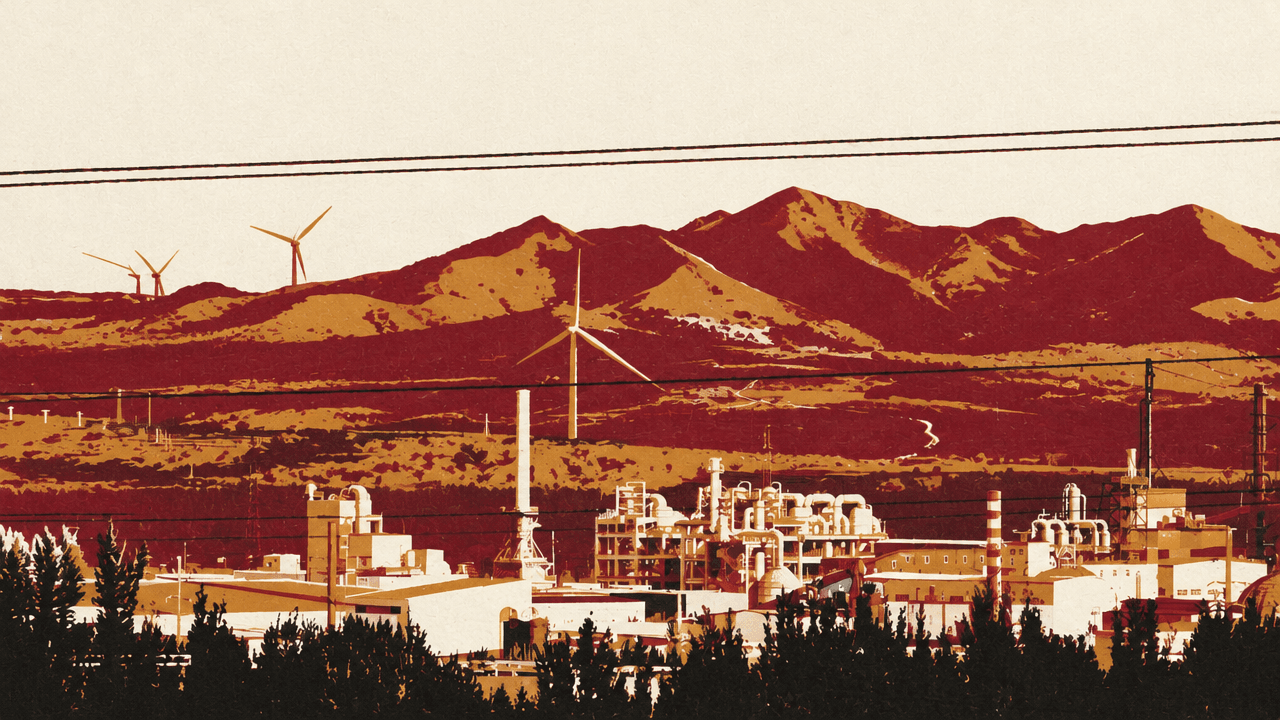
China’s industrial parks concentrate both its emissions and its decarbonization challenge
About 80% of Chinese factories sit inside industrial parks: specially zoned districts that share a power supply. These clusters account for approximately half of China’s GDP, but their manufacturing has historically run on coal. Lili Pike says China is both the world’s largest carbon emitter and a major producer of clean technology.
A separate chart, citing BloombergNEF’s 2024 data, compares clean-tech exports across regions and shows China’s bar far ahead of the others. The contrast is central to the industrial challenge: China has built a dominant manufacturing base, but much of that production has depended on energy from coal.
China’s manufacturing growth accelerated after it opened to trade in the 1980s and surged after joining the World Trade Organization in the early 2000s, Pike says. She puts the country’s trade surplus at more than $1 trillion last year. That scale of production requires substantial energy, and industrial parks have historically relied on coal.
In 2020, President Xi Jinping announced goals for China to peak emissions before 2030 and reach carbon neutrality by 2060. Pike says electric vehicles and wind and solar power have seen rapid progress; industrial production is a harder problem. Some factories can switch to renewable electricity, while others must change the processes that produce their emissions.
Beijing’s proposed approach includes zero-carbon industrial parks. In March 2022, China set a target to designate 100 over five years, with factories sharing renewable power. That national target is distinct from parks built voluntarily by private companies. Envision Energy, for example, has developed its own parks as well as participating in the broader shift.
Chifeng’s renewable power system has to operate without the main grid
At Envision’s Chifeng site in Inner Mongolia, the company makes green hydrogen and green ammonia using locally sourced wind and solar power. Adrianne Jeffries says Inner Mongolia is both one of China’s leading wind-energy producers and its leading coal producer. The region is trying to move toward clean energy while remaining central to coal production.


Chifeng operates independently of China’s main grid. Industrial production needs steady electricity, while wind and solar output fluctuates, so Envision cannot fall back on grid power when generation dips. Envision representative Deng Yunhui says the company makes its products using solar and wind power.
Ammonia, a widely produced chemical used in fertilizer, is made by combining nitrogen with hydrogen. Hydrogen is typically produced using fossil fuels. At Chifeng, an electrolyzer uses renewable electricity to split purified water into hydrogen and oxygen; the hydrogen is then combined with nitrogen to make green ammonia.
The production system has to adapt to changing power supply. Jeffries says Envision adjusted its electrolyzers to ramp up and down quickly and developed software that uses AI for weather forecasting. Deng says the model predicts wind and solar output five to seven hours ahead. Batteries currently provide backup when the wind is not blowing or the sun is not shining. A chart shown on screen plots sunlight and wind predictions over a four-hour timeline; Deng’s description of the model’s prediction window is five to seven hours.
Envision hopes to use green ammonia as a future backup fuel, generating electricity with turbines that use the ammonia. Jeffries describes this as a plan for the future, not an existing part of Chifeng’s power system. Envision transports its products to clients in South Korea and to other customers in the chemical industry.
Chifeng builds on Envision’s earlier work in Ordos, also in Inner Mongolia. Envision began as a wind turbine manufacturer in 2007 and has since expanded into batteries and other areas. It is involved in more than a dozen zero-carbon parks across China. Jeffries says the company used its Ordos plan to model what a zero-carbon park might look like, and applied lessons from that project in Chifeng. Ordos is part of Beijing’s pilot program; Chifeng is smaller, but its fully off-grid operation brings its own difficulty.
Capital, demand and industrial differences limit how quickly the model can spread
Building a zero-carbon park requires substantial upfront capital for renewable generation, technologies and transmission infrastructure. Jeffries says only a few companies, including Envision and Goldwind, have been able to make that investment. Ting Li sees industrial parks as useful laboratories: they can range from about 10 square kilometers to 100–300 square kilometers, or the scale of a small town, and offer a place to test what works locally.
The term “zero-carbon” does not always mean every unit of energy is renewable. Li says the current benchmark for a zero-carbon industrial park requires its energy-consumption portfolio to reach 90% green energy. Chifeng reaches 100%, according to the source; Li’s description of the benchmark is not a claim that every park operates at that level.
Demand is another constraint. Jeffries says demand for green hydrogen and ammonia remains low in China and worldwide. Envision has secured some contracts and is beginning to see interest in its products. The company says it is getting close to the price of conventional hydrogen and ammonia, but a gap remains. The national government has announced subsidies intended to create demand for green fuels.
The challenge also depends on the factory. A textile, phone or toy producer may be able to cut emissions relatively quickly by switching to green electricity. Steel and cement production can require a new set of technologies to reduce emissions, rather than simply a cleaner power supply.
Li says nationwide net zero is difficult and argues that parks offer a way to test approaches on a smaller scale before attempting broader change. She also points to growing regulation, domestically and internationally, aimed at controlling carbon emissions. Jeffries says these signals mean companies must prepare for a future in which a product’s carbon footprint matters more. The parks, she says, can serve as laboratories for decarbonization technologies and may leave Chinese companies better positioned to export them.