Illicit Revenues Help Sustain Myanmar’s Fragmented Civil War
 Matthew Campbell
 Thiha YarzarKyaw WaiMichelle Aung
 Aung KyiZin Wai
 Kyaw ThuraAyeBloomberg OriginalsThursday, August 20, 20269 min read
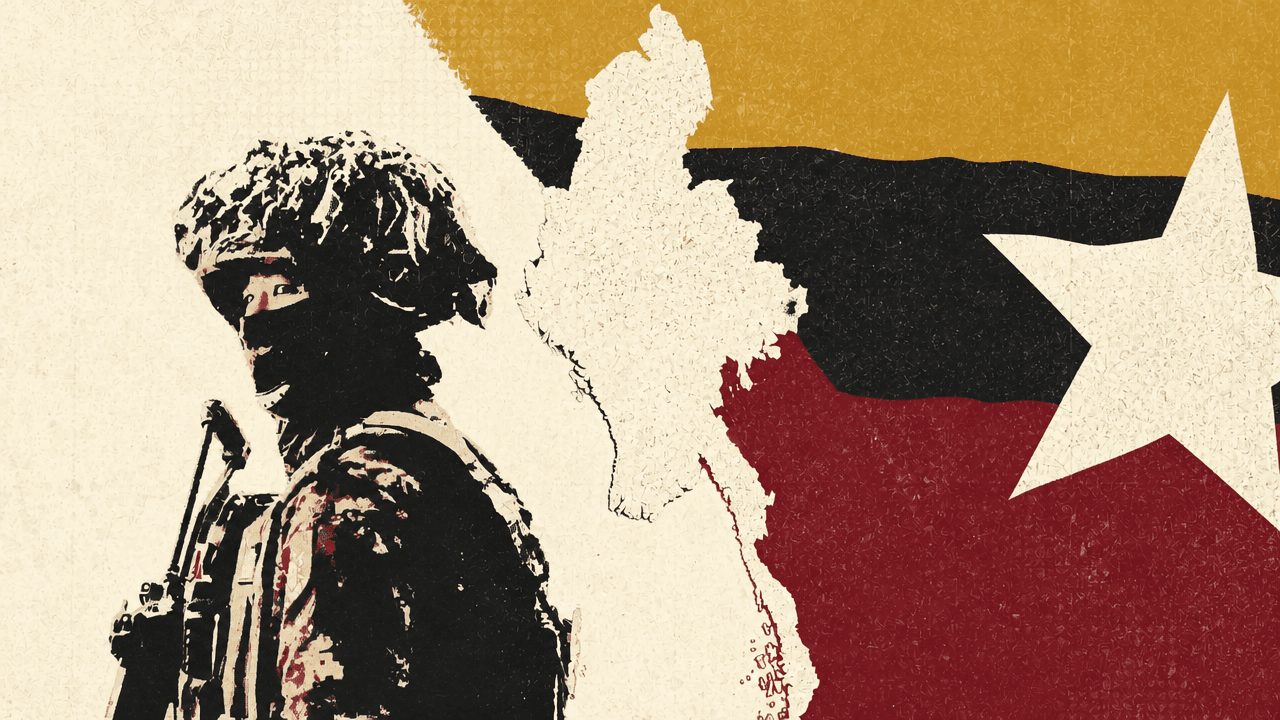
Bloomberg Investigates reporter Matthew Campbell argues that Myanmar’s civil war has become an income system as well as a struggle for territory and political control. With the military and its allies controlling an estimated 40% to 45% of the country, competing armed groups can monetize mining access, border crossings, illicit trade and scam compounds—revenues Campbell says can make continued war more profitable than peace. The result, the reporting shows, is borne by civilians displaced, impoverished and separated by a conflict with no decisive end in sight.
Fragmented control turns war into an income system
Matthew Campbell says Myanmar’s military uses events such as Armed Forces Day to project a picture of command: a choreographed demonstration of power, national unity and military authority. But he estimates that the military and its allies control no more than 40% to 45% of the country.

The military-control map shown with Campbell’s account marks only part of Myanmar as controlled by the junta. Beyond it lies a patchwork of armed authority. Campbell describes the civil war not as a clean contest between two unified camps but as a conflict involving the junta and its allies alongside more than two dozen rebel groups. Some have fought the state on and off for decades; some also fight one another.
That fragmentation makes territorial control economically consequential. The reporting documents armed control shaping access to ruby-mining plots in Mogok, the dangerous and costly movement of people across the Thai border, and the operation of illicit scam compounds in border territory. Campbell’s central argument is that the conflict is over territory and political control, but also over “dark money”: illicit trade, hidden resources and underground deals that can make war more profitable than peace.
This is a conflict about territory and political control, but it's also about money, particularly dark money.
The human cost runs alongside that system. Campbell puts the death toll at around 100,000, with hundreds of thousands injured and millions displaced. News footage included in the reporting describes more than 30,000 arrests in the five years after the coup and continuing mass displacement; another report shows the aftermath of an airstrike said to have killed seven civilians, including a child.
Myanmar became independent in 1948 and then entered, beginning in the 1960s, a period of repressive military rule, isolation and poverty, Campbell says. The political opening of the 2010s did not dislodge the military from power. Aung San Suu Kyi’s release from house arrest, her National League for Democracy’s 2015 electoral landslide and an economic boom were followed by the military’s 2021 coup.
After protests were met with escalating force, many protesters left cities for the forests. Students, young people and professionals joined older ethnic armed groups and became guerrilla fighters. The result overlaps democratic resistance, long-running ethnic armed movements, local territorial disputes, resource extraction and criminal enterprise without reducing them to a single unified cause.
Displacement turns escape into another market
At Thettawshay Monastery in Sagaing, Zin Wai describes fleeing when a military platoon was stationed in her village. Her baby was three months old, and she says the family had only about 5,000 kyat—$1.10—when they escaped.
The roads were crowded with others fleeing. Zin Mar Wai compares the scene to cattle being released in the evening. In the crush, she says, a motorcycle hit them and someone stepped on her postpartum stitches. She traveled for months with her two daughters before finding refuge at the monastery.
Then came the March 2025 earthquake. Zin Mar Wai says one of her children was crushed beneath a three-story school building. Her body was found on the fourth day. The family never returned to its village and has remained at the monastery since.
She hopes the village can eventually be rebuilt so her surviving daughter, now four, can attend school. But the war leaves displaced families with little ability to determine where they live, whether they can return or what schooling their children can receive.
We've reached a life where we have nothing left. Because of that we have to try twice as hard to raise our children. We just want things to return to how they once were.
The border with Thailand offers safety for some people, but at a cost. Campbell’s reporting from the edge of Shan State depicts a landscape divided among the Wa National Army, a militia associated with the Burmese military, the Shan State Army South and the Thai army. One hilltop can belong to one armed group and the next to another.
Michelle Aung says her husband went into hiding and received military training after becoming involved in the protest movement. When soldiers came looking for her, she escaped with her baby by climbing from an upstairs bathroom onto the wall of a neighboring house and hiding in the backyard.
Michelle decided to flee to Thailand. Hundreds of thousands of others have done the same, Campbell says, often crossing illegally and creating a market for people smugglers. A photo supplied by Michelle and displayed in the reporting records what she paid: 18,000 baht, or $545, to cross with two children. She says a normal crossing cost was 800 baht, or $24.
Smugglers told her to leave her belongings and cross only with what she could conceal on her person, she says. She hid her phone and money, walked through the forest in the evening and slept in a small hut beside a cemetery.
In Thailand, she says, her family could not go to school, even trips to a nearby shop were difficult, and poor health prevented her from working. Relatives sent money. Her expectation of returning to Mandalay gave way to living day by day.
Her husband has never met their daughter. Michelle says that in one message he told her he would continue the revolution until the end, asked whether she and their daughter were still alive somewhere in the world, and sought forgiveness if he could never return.
A fortified elite and fuel queues show the unequal terms of war
In Naypyidaw, Campbell describes a neighborhood of generals, senior officials and ministers where every house sits behind a wall and razor wire. The capital itself appears closed off from the rest of the country. He presents that insulation as a stark contrast with conditions during what he calls an unbelievable economic collapse, and with the money fueling the civil war that ends up with people in such neighborhoods.
In Naypyidaw and Mandalay, the reporting also finds enormous queues of vehicles for fuel. Myanmar had imposed strict fuel restrictions, adding another constraint to daily life during the conflict. Kyaw Wai, identified as truck driver Kyaw Thet Wai, says he began queuing at around 4 a.m.; the wait reduced time with his family and left him unable to repair his truck. Aye expected vehicles would not be filled until the following morning.
Mandalay nonetheless retains what Campbell calls a veneer of normalcy. Commerce continues, and the city remains a center for commodity flows. That position matters in a country he describes as rich in gemstones, timber, copper and other natural resources.
Control of Mogok changes who can mine and on what terms
Some rebel groups are fighting for ideological reasons, Campbell says, while others are also seeking control of natural resources. Mogok, a ruby-mining town, shows how a change in territorial control can alter access to a local industry.
Kyaw Thura, a gemstone trader originally from Mogok, says gemstones also come from Sri Lanka, Vietnam and Africa, but Mogok gems are lower in quantity and high in quality. A displayed The Diplomat headline, dated July 25, 2024, identifies a Myanmar resistance group claiming capture of the ruby-mining town; Campbell says the group was the Ta’ang National Liberation Army, or TNLA.


After taking control of Mogok in 2024, Campbell says, the TNLA began charging local diggers for the right to work their plots. A change in control of the town therefore changed the terms on which local people could access its principal resource.
Kyaw Thura says local people could no longer freely approach the land or work there. But forest mining is difficult to monitor, he says, and people try to work around the system because they need to survive. The risk remains constant: heavy weapons can land at any time, and fighting can break out without warning.
The TNLA offers a different characterization. Its spokesperson, Lway Yay Oo, says the group treated miners fairly while collecting legitimate taxes.
Scam compounds can generate far more than resource rents
Gemstones are a major industry, Campbell says, but the more significant money is in scam centers along the Thai-Myanmar border. He joined a Thai army patrol near Shwe Kokko, which he describes as allegedly one of the largest scam centers in Southeast Asia. The location map shown during the patrol places Shwe Kokko directly across the border from Thailand.
Signs along the Thai side warn people who answer job advertisements for customer-service work that what awaits them across the river may be far more sinister, Campbell says. Many workers are trafficked and essentially held prisoner; others arrive voluntarily, attracted by offers of generous pay.
A former scammer, whose identity was concealed for safety and whose testimony was voiced by an actor, says a friend offered free room and board and a starting salary of 30,000 baht, about $900.
The former worker says bombs passed overhead regularly, and that the danger became familiar over time. His job was presented as crypto trading. In practice, he says, customers were urged to download a foreign-exchange application, convert money into a coin, then transfer those coins to a separate application controlled by scammers.
Once a customer made that transfer, he says, the coins were in the scammers’ account. The model depended on repeated fraud: roughly $100 on the first occasion, then about $1,000, followed by around $10,000 on a third attempt.
Sites like Shwe Kokko generate, “by most accounts,” billions or even tens of billions of dollars in revenue, Campbell says. In his account, that money goes into the pockets of various combatants in the war.
Thiha Yarzar, a pro-democracy campaigner, makes a more direct allegation: scam proceeds go to the military junta. He says sanctions have frozen many of the regime’s resources, and that scam operations give it money to fight its own people. In his account, the junta is focused on its families, relatives and military interests rather than the country’s people.

The military-backed government denies that government officials profit from scam centers. Its spokesperson, Khaing Khaing Soe, declined to comment on the killing of civilians and said the government regarded fighting online scam centers as a national responsibility, working aggressively with regional neighbors to crack down on them.
Political power and illicit revenue can reinforce a war without resolving it
Myanmar’s military leadership has also sought political legitimacy through elections. News footage in the reporting describes military chief Min Aung Hlaing being elected president, while opponents characterize the poll as an attempt by the army to gain legitimacy internationally.
Thiha Yarzar calls it a fake election in which the military “elected themselves.” Continued power, he argues, protects the military’s ability to pursue its own business interests.
As long as they have power, they can do their own business. As long as the war exists, they can make money.
Campbell sees little prospect of the war ending soon: no side is winning decisively on the battlefield, while substantial money is being made. The reporting identifies distinct mechanisms rather than a single uniform financial system—payments for mining access in Mogok, alleged revenues from scam compounds, and broader illicit trade and underground deals.
Neither junta nor rebel control, Campbell says, means that much of this money reaches ordinary people. The contrast is not abstract. It is Zin Mar Wai trying to raise a surviving child after losing another while displaced. It is Michelle paying hundreds of dollars to get her children across a border, unable to enroll them in school and separated from a husband who has never met his daughter.