WWE’s Global Growth Depends on Keeping Core Fans and Finding New Stars
WWE president Nick Khan says the company’s commercial decisions must not come at the cost of its core fans. That constraint shapes choices such as where WWE stages major events and how it prices tickets, even when another option might bring in more revenue. In his account, growth depends on making those decisions with the audience in mind, rather than treating revenue as the only measure.
Revenue matters, but WWE cannot afford to lose its core audience
For Nick Khan, the central business constraint at WWE is not to lose the core fan base. Asked how he balances the demands of quarterly earnings and growth with the integrity of the product, Khan returned to that audience: the company has to keep its core fans. The commitment shapes where WWE stages major events, how it prices tickets and how it makes programming available.
Khan pointed to SummerSlam, one of WWE’s biggest events, which the company held as a two-night stadium show in Minnesota. The region has been a wrestling center for decades, he said, tracing that history back to the American Wrestling Association. WWE could have chosen a city where it might have generated more revenue. But the company also wanted to bring a major event to Midwest fans. Its venue decisions weigh finances alongside geography and local demand, while avoiding too much supply in a particular part of the country, which could weaken demand.
That is a practical answer to the tension between growth and audience loyalty: the financial return matters, but it is not the only consideration. Khan said WWE wants fans in a longstanding wrestling market to have the opportunity to attend a major show, even if another city might produce more revenue. The company still has to make commercial choices, but those choices should not lose sight of where its audience is.
The same tension appears in ticket prices. WWE tries to charge as much as possible for its most expensive seats, which Khan said are aimed at buyers who can afford them. For the upper bowl, the company wants tickets to remain family-friendly—but not so cheap that customers simply buy them through third-party brokers. His answer is not a single price point for all fans, but a strategy that distinguishes between types of seats.
Khan connected the question of preserving the product to a broader operating principle: pay attention to what consumers want, and make many small decisions well. He compared the process to building a business through a thousand good transactions rather than relying on one major deal. He applied that idea to WWE’s creative choices as well as its pricing. He did not describe a formula for protecting creative integrity from commercial pressure; his answer was that the company has to keep its eyes open to consumer demand while making those decisions.
The next star should not be a copy of the last one
Khan rejects the idea that WWE should search for “the next John Cena.” Cena, like Alex Rodriguez in baseball, is a one-off, he said. The next star will not necessarily resemble the last one; the task is to notice what audiences are looking for and where fresh talent might come from.
WWE still recruits from independent wrestling, but Khan said the company shifted its approach about six years ago to expand college recruiting. The pool included athletes who had played football at Georgia Tech, the University of Iowa and the University of Miami—among them Roman Reigns, Big E and Dwayne “The Rock” Johnson. The company then asked why recruiting should stop with football players.
Khan described sending the person who performs as the Undertaker to speak at college campuses, including to male and female athletes in track and field. The message was that WWE hoped they would reach the Olympics or achieve their ambitions in sport, but that wrestling could be another path if they did not.
He offered Oba Femi as an example of the approach. Femi was a shot putter at the University of Alabama. Khan said the Undertaker noticed his size and strength during a campus visit. Femi had grown up in Nigeria before coming to the United States and had not developed the football background that had been a common route into wrestling. WWE saw athletic ability that could translate to the ring. Khan described Femi as one of the company’s big superstars and a possible next big thing, while stressing that he does not look or feel like an earlier wrestler.
The next one never looks like the last one.
Clear roles help TKO’s leaders work together
TKO brought WWE and UFC together under one company, with several high-profile executives in senior roles. Asked how he manages the group, Nick Khan described the division of responsibilities: Ari Emanuel is TKO’s CEO, Mark Shapiro its president and day-to-day operator, Dana White runs UFC, and Khan oversees WWE. The group has also launched a boxing company.
That clarity, he said, keeps people from crossing into one another’s roles. He called it the easiest part of his day and said TKO’s leaders believe the company is only getting started, pointing to the stock’s performance as a reflection of collective success.
One surprise since the merger has been the continued interest in live events. Khan said TKO had expected people to value events they could not replicate at home. He stopped short of calling the business recession-proof, but described it as “technology-proof”: a live event cannot be recreated at home. He also sees every alternative use of a person’s time—including staying home to watch TikTok or text friends—as competition for attention.
Khan also described listening as a skill that carried over from talent representation into running a public company. People like to talk about themselves, he said; he and his friend Jamie Horowitz joke that a meal feels successful when they have let the other person do most of the talking. The work is to listen well and offer feedback on what the other person is actually interested in hearing.
Weekly programming made WWE a fit for Netflix
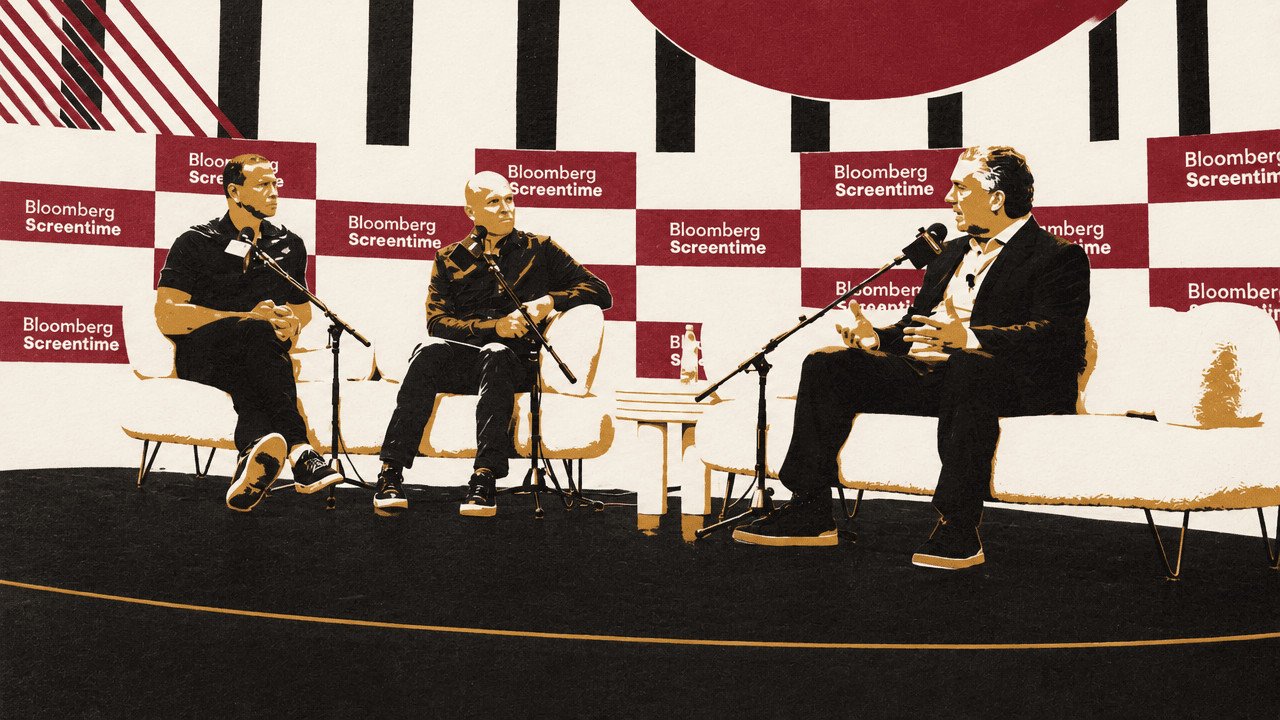
WWE’s agreements with Netflix and ESPN place different parts of its programming on different platforms. Nick Khan said Monday Night Raw streams globally on Netflix. Premium live events—previously called pay-per-views—are available through ESPN Unlimited without an additional event-by-event charge. A Bloomberg headline shown during the discussion put the value of Netflix’s Raw deal at $5 billion.
Khan’s account focused on how the Netflix negotiation came together. He described it as fast and relatively free of bureaucracy. Netflix had previously said it would not enter live programming, he said, then tested adjacent formats and changed other policies as its business evolved.
Khan said the opportunity came as Netflix was looking to grow subscribers and had entered advertising. WWE’s year-round schedule was part of his explanation for why the property fit that effort: rather than trying to sell ads around a limited series with six episodes, WWE could offer advertisers 52 weeks of programming.
TKO executives Mark Shapiro and Ari Emanuel contacted Netflix leaders Ted Sarandos, Greg Peters and Bela Bajaria about WWE’s upcoming deal. Netflix agreed to meet within days, around December 1, and said it would make an offer before Christmas. Khan said the offer came, the parties closed and documented the agreement, and then announced it.
Putting programming on different platforms can help maximize distribution, but it also asks viewers to know where to look. Jason Kelly described the familiar frustration of going to one streaming service for a sports event and finding it elsewhere. Khan’s response was that companies should not assume customers understand the arrangements—or even the terminology. “Authenticate,” for example, may be clear to people inside a media company but not to everyone trying to watch.
For the ESPN launch, WWE had its wrestlers—whom it calls superstars—make short videos explaining what to press and which cable or satellite customers could watch at no extra cost. Khan said the aim was to show viewers what to do rather than assume they already knew. WWE also uses its social channels to remind followers when and where to watch Raw. For Khan, clear instructions are part of making a distribution deal usable, not a detail that can be left to the audience to work out.
WWE has 600 million social media followers, Khan said, and they are vocal about what they think. He views that response as a sign of fans’ attachment: supporters talk about a team as if they own it, saying “we lost” when it loses. If things are going badly, the company wants to hear from them. When things go well, fans may say less because success is expected. Khan considers that part of the business, not a problem to be managed away.
International growth means putting talent and shows in local markets
Nick Khan said WWE decided six years ago that it could not rely on exporting American programming and expect it to resonate everywhere. The company needed to be “boots on the ground” and give audiences what they want. In his view, that includes talent from the places where WWE performs, so local fans can root for someone who represents them.
He contrasted this with a past convention in which American wrestlers were cast as heroes and foreign wrestlers as villains. That approach, he said, reflected its era. Today, WWE wants international audiences to see versions of themselves in the talent. Khan cited recent shows in Chile and Bogotá, along with four nights in Mexico City, as examples of the company staging more events outside the United States. He said WWE would do more of that, and confirmed that the next WrestleMania would take place in Riyadh.
Zuffa Boxing is betting on organization and storytelling
Nick Khan said TKO prefers sports where a company can control or influence a central operation, rather than buying teams or pieces of teams. UFC and WWE fit that model. Boxing, he argued, is another fragmented sport where there may be room to bring the business together.
He contrasted boxing with wrestling and mixed martial arts, which he said had evolved, while boxing had remained essentially the same product since his childhood. He recalled a time when fans could readily name the fastest man in the world, and listed individual athletes such as Sugar Ray Leonard among the stars who defined their sports. In his view, boxing has not developed in the same way around a consolidated structure.
Khan said Zuffa Boxing had been operating for ten months and was already profitable. He cited a recent Ryan Garcia–Conor Benn fight around Mexican Independence Day in Las Vegas, which he said drew a large gate and strong numbers on Paramount+. TKO has partnered with a Saudi group that Khan said had taken a significant role in boxing; WWE has worked with that group in the Kingdom for eight years. TKO is the boxing operation’s sole operator, with Dana White as promoter. Khan said the company had the right partners and business team, but still had to put on a good product.
Khan relayed a comparison from broadcaster Max Kellerman: at a four-way stop, two people fighting would draw attention over someone putting a golf ball, shooting a basketball or throwing a football. But the comparison changes if those athletes are Tiger Woods, Michael Jordan and Peyton Manning in their prime, while the fighters are unknown. Khan’s point was that the spectacle of a fight alone may not be enough to distinguish a boxing event; the names and the stories around the fighters matter. If Zuffa can get the storytelling right and bring in the right fighters, he said, he thinks it has a good shot.
Khan plans to stay and build
Nick Khan declined to name another business he would like to enter. Asked about his own next five to seven years, he described a career that had moved from law to ICM, then CAA, and then WWE. He has spent six years at WWE and said he likes where he is and where the company is. His plan, for now, is to stay and see what the organization can achieve.