Electricity Grids Become the New Bottleneck for AI Growth
 Caroline HydeEvan EnsslinÁlvaro HurtadoSamson Abiamuwe
 Richard MillerDaniel Martínez
 Akshat Rathi
 Dan Murtaugh
 Guy NicholsonLiam HowellLaura Millan
 Tim HeidelJason ThomasBloomberg OriginalsWednesday, May 27, 202612 min read
Bloomberg Primer argues that electricity grids have become a central constraint on economic growth as AI, electric vehicles and heat pumps push demand higher after decades of flat consumption in many Western countries. The piece contrasts China’s continuous grid buildout with stalled Western systems, and follows efforts including superconducting cables, grid-stabilizing machines for renewable-heavy systems and Nigerian mini-grids. Its central claim is that countries able to expand and stabilize power delivery will be better positioned to capture the next wave of industrial and digital growth.
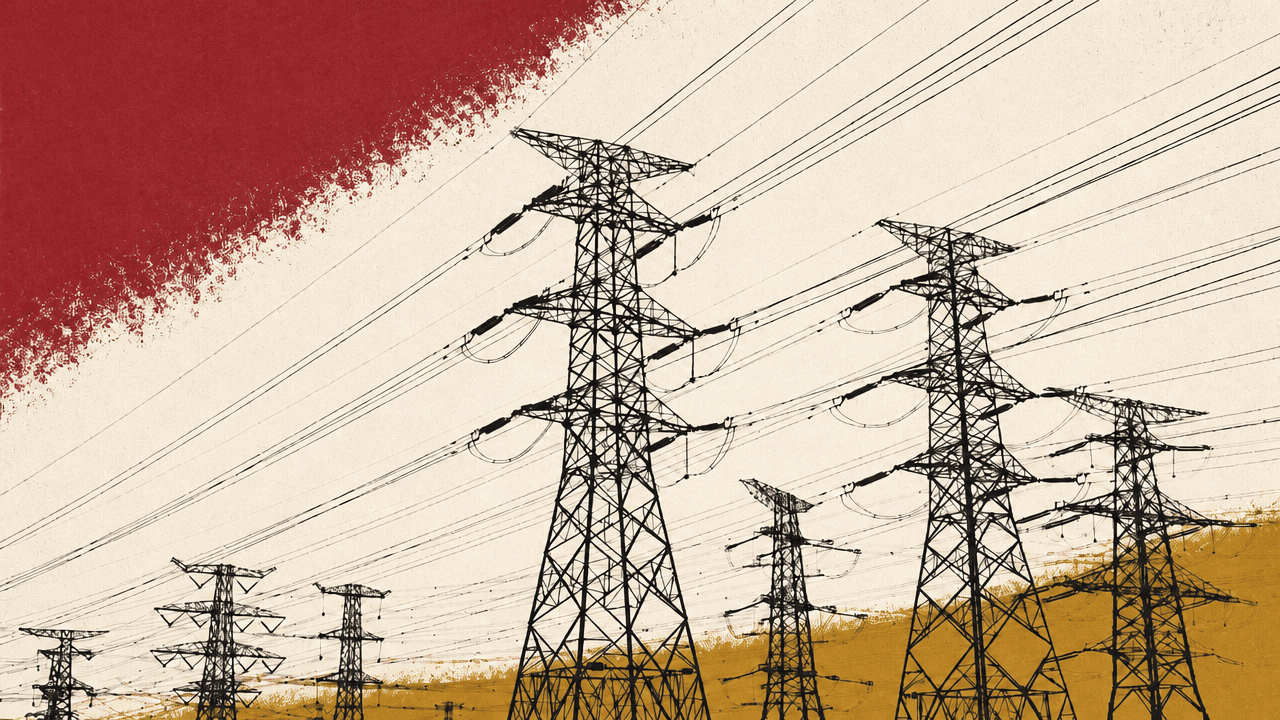
Electricity demand is no longer flat, and the grid has become an economic constraint
For roughly two decades, Western electricity systems benefited from a condition that now looks temporary: demand was flat or declining even as GDP kept growing. Bloomberg’s account traces that plateau to two broad changes. After the 1970s oil crisis, utilities and customers had strong incentives to use less energy; Rich Miller, a former vice president at Con Edison, says that was when “the first big movements in energy efficiency began.” Con Edison’s own slogan shifted from “Dig We Must” to “Save a Watt,” a small marker of a larger turn toward conservation. At the same time, rich countries moved away from energy-intensive manufacturing and toward office work.
That phase is ending. Miller says the industry is now seeing growth in demand and consumption again. The source identifies three main contributors: the shift from gasoline cars to electric vehicles, the replacement of oil furnaces and gas boilers with heat pumps, and the growth of artificial intelligence, which depends on data centers that use large amounts of electricity.
Jason Thomas gives the scale of current AI-related spending in blunt terms: four companies are now intending to spend more than $300 billion this year. The source does not treat that spending simply as a technology story; it treats it as a power-delivery story. According to the International Energy Agency projection shown in the piece, global electricity use is expected to roughly double by 2050, from the tens of thousands of terawatt-hours range in 2023 to about 60,000 TWh by mid-century. Bloomberg frames that as the equivalent of adding roughly “a whole new USA’s worth of electricity every five years.”
The economic stakes are presented as symmetrical: AI could add substantially to output, but only if the physical power system can support it. A PricewaterhouseCoopers estimate shown on screen puts AI’s potential boost to the global economy at as much as 15% over the next decade. Another visual, attributed to the International Energy Agency, says AI could use as much electricity as Japan by 2030.
Akshat Rathi states the dependency directly: meeting new electricity demand means the entire grid has to become bigger. He adds that this is the first time in three decades the industry has faced that kind of growth, and that the industry has been caught unprepared. The source’s explanation is not that grid operators forgot how electricity works; it is that industries that stop building at scale lose muscle. Supply chains atrophy, infrastructure becomes outdated, and workforces shrink or age out.


The grid, in this telling, is not background infrastructure. It is a limiting input to the next phase of economic development. Rathi puts it in a compressed form: “Energy is destiny.” If a country cannot build out the grid, he says, it loses out on being a competitive economy in the 21st century.
China kept building while Western grids went quiet
The contrast with China is central to the source’s argument. In Western economies, grid growth slowed after demand flattened. In China, according to Dan Murtaugh, grid construction has continued “basically nonstop since the 1990s.” That means China still has a large skilled labor pool and a mature supply chain able to grow as needs grow.

Murtaugh ties the difference to China’s continuing industrial expansion. China still does much of the manufacturing that Western countries moved away from, and its grid had to expand to support that work. He also notes that China still has rapid economic growth by developed-economy standards: “A bad year here is 5% growth,” much higher than what is normally seen in the US or Europe.
The numbers shown in the source are stark. While US electricity demand remained relatively flat after 2000, China’s power generation rose sevenfold over the same period. A chart attributed to Ember and Our World in Data compares the US and China from 2000 to 2024, with China climbing steeply toward the 10,000 TWh range while the US line is comparatively stable.
| System | Pattern described in the source | Implication |
|---|---|---|
| Western economies | Electricity demand was flat or declining for roughly two decades | Grid expansion, supply chains, and workforces lost momentum |
| China | Power generation rose sevenfold since 2000 | Grid construction, skilled labor, and supply chains kept expanding |
Murtaugh’s personal observation is used to make the statistical shift tangible. He says that when he moved to China 29 years ago, he would pass people living in “huts and hovels” on the way to school. Now, in cities such as Shanghai or Beijing, he sees brightly lit skyscrapers. The point is not nostalgia; it is the visible relationship between electrification, industrial capacity, and modern urban growth.
That relationship is one of the source’s governing claims. Electricity consumption and economic output reinforce each other. Rathi says richer economies consume more electricity and have bigger grids; bigger grids support more electricity consumption; and that, in turn, supports more wealth creation. The source traces the same loop historically in the United States: in 1910, 14% of US homes had electricity; by 1930, 70% did. Once electricity could be delivered by wire, companies such as GE sold millions of fridges and TVs, and the grid expanded with consumer demand.
The present version of that loop is no longer primarily about household appliances. It is about data centers, electric vehicles, heat pumps, manufacturing, and the ability to host the industries that follow cheap, reliable, abundant power.
Higher-capacity cables could relieve bottlenecks, but utilities may resist the risk
One response to rising electricity demand is to move more power through the physical corridors that already exist. That is the problem Veir, a company in Woburn, Massachusetts, is trying to solve with superconducting transmission lines.
Tim Heidel, Veir’s chief executive, argues that simply expanding the grid in conventional ways is “far too slow” for the coming decades. He says superconducting transmission lines could carry much more power than conventional lines in a compact space.
The source explains the engineering premise by starting with ordinary conductors. Typical power cables use materials such as copper and aluminum, which have low resistance and therefore lose relatively little energy as current passes through them. Plastic, by contrast, has high resistance and is used for insulation. Veir’s cable uses a superconducting material that, under specific operating conditions, has no electrical resistance. Heidel says that when a material can be operated without resistance, it can carry “a lot more power in a very, very compact space.”
The promised grid benefit is straightforward: a single superconducting cable could carry as much power as several conventional cables. That could help move electricity to data centers, homes, and EV chargers without requiring as much new infrastructure.
But the source emphasizes that this is not a simple substitution. The cables have to be extremely cold to enter their superconducting state. Evan Ensslin describes Veir’s test bed as full of liquid nitrogen at about 77 Kelvin. A temperature graphic places the superconducting cable at -321°F, colder than the dark side of the moon and warmer than space. The equipment needed to test the cables is itself power-hungry: Ensslin says the large power supplies draw almost all the power from the building, requiring the team to watch that the machine shop is not using something powerful at the same time so they do not overload the grid.
The manufacturing process is also early. When Bloomberg visited in 2025, Veir was starting to produce 10-meter cable sections. Liam Howell says the assembly line was moving “extremely slow,” with a cable typically taking about two weeks to make. He contrasts that with normal cable manufacturing, where the reel spins so fast that the motion is difficult to see. Howell expects much of the manual work to be automated and the process to become faster.
Veir has raised $116.9 million, according to a PitchBook-sourced visual in the piece, with investors listed including Tyche Partners, SiteGround, Piva Capital, National Grid Partners, Munich Re Ventures, Microsoft, and Dara Holdings. The company says it aims to have its first cables on the grid within a couple of years.
The constraints remain substantial. The system needs vacuum tubes and a continuous supply of liquid nitrogen, which could add a premium over conventional cables. And the customers Veir needs to persuade are utilities, which the source describes as conservative businesses for understandable reasons: if a company is responsible for providing power continuously, it will be cautious about new technology.
Heidel does not claim superconductors will become the only choice. His claim is narrower: their power density will allow them to “increasingly dominate conversations around future transmission systems.” In the source’s framing, superconducting lines are not a full answer to grid expansion. They are one possible way to increase throughput where land, permitting, construction timelines, or existing corridors limit conventional buildout.
A grid with more solar still needs inertia
The source’s second major technical problem is not moving enough power, but keeping the system stable as generation changes. The case study is the April 28, 2025 blackout across large parts of Spain and Portugal, described by Laura Millan as “the worst blackout in Europe’s modern history.” The outage left millions of people without power. People were stuck in metros and trains; shops and supermarkets could not operate because payment systems were down. A Bloomberg headline shown in the piece reported that Spain’s largest bank, La Caixa, calculated €400 million was wiped off the Spanish economy.
The source says the power returned within about 18 hours, and for many people the outage was merely inconvenient. But it treats the blackout as structurally important because of what it exposed about the modern grid. Millan says that, for now, the known facts include instability coming from some solar farms in southern Spain.
The source is careful not to present this as a simple anti-renewables argument. Spain has added significant solar power, and the piece identifies solar’s advantages as clean, cheap, and versatile. A BNEF-attributed chart shows global solar capacity rising sharply from 2014 to 2024, reaching the low thousands of gigawatts. Guy Nicholson, who works for Statkraft, says many people blamed renewables for the Spanish situation, but “renewables did exactly what they were told to do.” His diagnosis is that the failure was foreseeable because the system needed a stability service that solar does not inherently provide.
The key concept is inertia. To function, the grid has to keep electricity supply and consumption matched second by second. If supply and demand fall out of balance, voltage can spike and parts of the grid can disconnect to avoid damage. Nicholson describes the resulting failure mode as a domino effect: one thing falls over, causing the next thing to fall over, until the whole grid goes down.
Traditional power plants provide a buffer because they contain large spinning machines. Coal, gas, nuclear, and hydro plants use rotating generators with substantial mass. Rathi connects this to Newtonian inertia: a spinning object tends to keep spinning unless a force acts on it. In grid terms, that spinning mass can provide a small amount of extra energy in an emergency. If a power plant suddenly goes down, the rotating machine can slow slightly and convert some of its stored kinetic energy into the electricity needed to stabilize the grid.
Solar panels do not work that way. They convert sunlight directly into electricity, with no spinning generator and therefore no inertia. The source says Spain tripled the amount of solar it added to the grid in the previous five years. When a couple of solar plants suddenly went offline, the source says there was not enough inertia to restore balance.
Nicholson’s proposed tool is a synchronous compensator: a 100-ton electrical machine spinning at 1,500 RPM. It resembles the spinning equipment inside a coal or gas plant, but without the coal or gas. Its purpose is to provide inertia so a grid can run with more renewables while maintaining stability. Nicholson says Statkraft had been thinking about exactly this problem, and that what he hears “on the grapevine” is that Spain may do similar things.
Rathi says Spain’s parliament moved quickly after the blackout, passing regulations that would allow more types of devices, including synchronous compensators, to participate in stabilizing the grid. A Montel News screenshot shown in the source carried the headline: “Spanish government passes law to help prevent blackouts.”
The Spanish example gives the source one of its main tensions. Clean generation can help meet rising demand, but a grid is not only a collection of energy sources. It is a synchronized machine. Replacing fossil-fuel generation with solar changes not only the emissions profile and marginal cost of power, but also the physical services the grid receives from the machines attached to it. If those services disappear, they have to be replaced.
In places without full grids, the next buildout may start small
The final part of the source shifts from rich-country grid upgrades to countries and regions that still lack basic electricity access. Caroline Hyde says sub-Saharan Africa has more people without electricity than any other region on Earth: about 565 million. In many places, grids are limited to urban areas, leaving large rural areas in the dark.


The source presents mini-grids as a different route to electrification. Unlike traditional grids, which can cover thousands of square miles, a mini-grid serves a much smaller area, such as a village or small island. In Kiguna, Nigeria, beyond the reach of the main grid, private companies can bring electricity in pieces rather than waiting for a national transmission network to arrive.
Samson Abiamuwe, formerly associate vice president, commercial, at Husk Power, says a mini-grid serves about 400 community members on average. Husk Power has installed dozens of solar mini-grids across Nigeria. Abiamuwe says its mini-grids run 24 hours, allowing households to power appliances such as fans and TVs, and allowing children to do homework at night.
The economic case is deliberately small-scale but not trivial. Hyde points to machines such as a rice mill, which can help residents earn more income. The source contrasts that with a multi-billion-dollar data center, but the point is that electricity-backed productivity starts somewhere. The analogy is to US rural electrification in the 1930s, when the government spent billions extending power across rural areas and helped support the country’s economic rise.
In Africa, Hyde says, a similar project is beginning. Mission 300, backed by the World Bank, aims to get electricity to 300 million Africans by 2030. A World Bank-attributed visual in the source lists $50 billion in investment pledged so far and an electrification goal of 300 million Africans by 2030.
| Effort | Scale shown in the source | Goal or use |
|---|---|---|
| Husk Power mini-grids in Nigeria | About 400 community members per mini-grid, according to Abiamuwe | Local 24-hour power for households and small businesses |
| Mission 300 | $50 billion pledged so far | Electricity access for 300 million Africans by 2030 |
The source’s implied sequence is incremental. A village may begin with a local solar mini-grid. Over time, multiple mini-grids can be interconnected into a larger grid. Abiamuwe argues that if every citizen has access to electricity, businesses will prosper, unemployment will fall, people will be able to do more for themselves, and “life as a whole will be better.”
This is the same electricity-growth loop described earlier, but at an earlier stage of development. In advanced economies, the issue is whether the grid can support AI, EVs, heat pumps, and a more electrified economy. In rural Nigeria, the issue is whether electricity can reliably power lights, fans, televisions, homework, and milling machines. In both cases, the grid is treated as a precondition for broader economic activity.