AI Demand Is Stress-Testing the Global Semiconductor Supply Chain
 Ian King
 Carol Massar
 Mark FuselierMike HaggertyAllen WanPriya ThanigaiKonstantinos Ninios
 JoAnne Feeney
 Debby Wu
 Jos BenschopBloomberg OriginalsThursday, May 7, 202612 min read
Bloomberg’s primer argues that the AI boom is turning the semiconductor supply chain into a strategic stress test, raising demand for advanced processors while exposing how dependent the industry remains on a handful of companies, machines and manufacturing clusters. The source traces that pressure through ASML’s lithography tools, AMD’s AI chip designs, TSMC’s concentration of advanced fabrication in Taiwan, and competing US and Chinese efforts to rebuild domestic capacity. Its central claim is that chips are becoming more economically and politically essential just as their production remains physically fragile, capital-intensive and difficult to replicate.
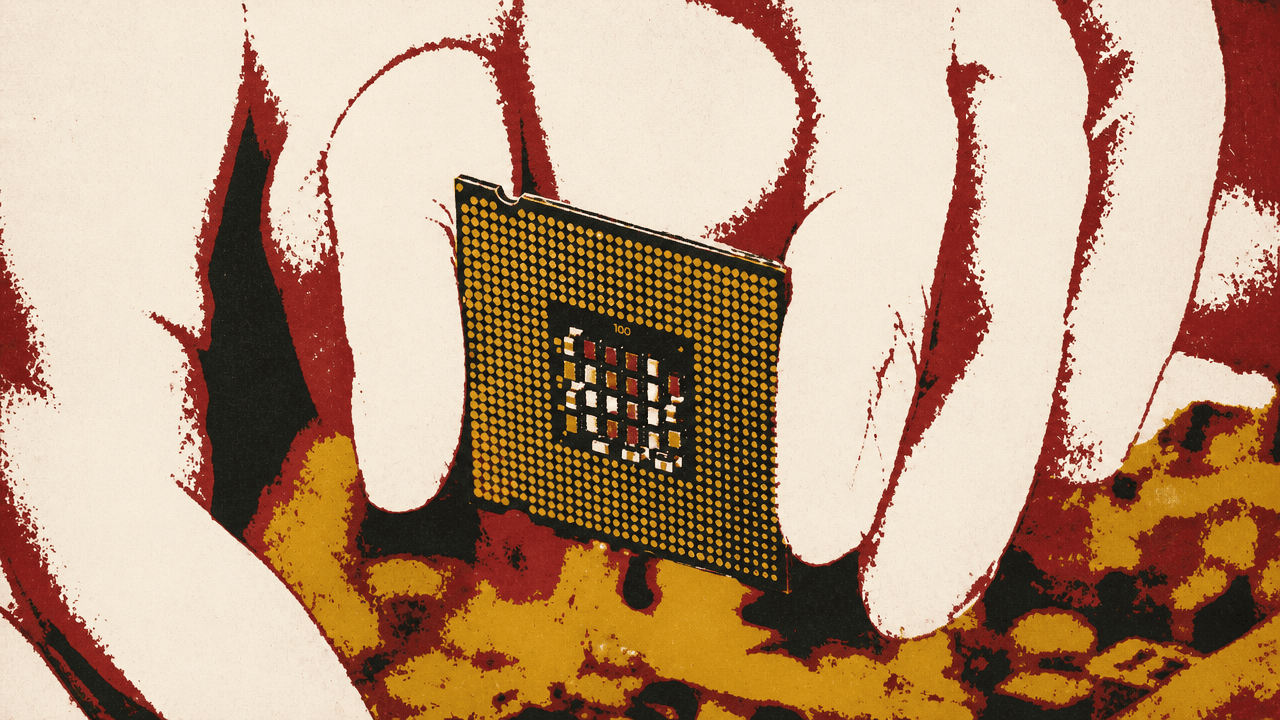
AI demand is turning a concentrated chip system into a strategic stress test
The semiconductor industry was already one of the most technically demanding systems in the global economy before the current AI boom. The source frames the industry as both enormous and physically delicate: about a trillion semiconductor devices ship every year, roughly 100 for every person on earth, while the smallest components on today’s chips are described as smaller than a virus and about 50,000 times smaller than the width of a human hair. A single skin cell, one factory guide says, can kill a chip.
That fragility now sits inside a market expected to reach $1 trillion in revenue in 2026, with AI presented as the major accelerant. The demand signal has shifted from familiar consumer replacement cycles — the next phone, the next PC — toward data centers and AI infrastructure. Spending on AI infrastructure, including data centers, is projected in the source to soon cross $1 trillion.
JoAnne Feeney says chips have become difficult to separate from the modern economy itself. “It’s very difficult to find anything that you can plug in or that runs on a battery that doesn’t have a semiconductor of some form in it,” she says. The AI buildout adds a new layer of demand on top of that ubiquity. Feeney argues that semiconductors are entering a more sustained growth period than the older pattern in which demand depended heavily on upgrade cycles for PCs and other consumer devices.


The source distinguishes between basic or “essential” chips and advanced chips. Basic chips, including many analog components, handle functions such as sensing, power management, and switching. Advanced chips include CPUs and GPUs, the more complex processors that perform heavier computing tasks. The most specialized AI chips are described as being designed not only to run software but to create it, processing large volumes of data in milliseconds.
At AMD, Mark Fuselier shows that the difference is not just conceptual. A PC chip, a server chip, and an AI product differ dramatically in physical silicon. Fuselier points to an AI package with a much larger central region made up of many chips, some stacked on top of others, and eight chiplets around the outside where memory is stacked 12 layers high. The purpose, he says, is “more energy efficient AI compute.”


AI chips accounted for more than a quarter of all chips sold in 2025, according to the source’s Gartner-attributed graphic, and are expected to account for more than half by 2029. That change matters because it pulls on every part of the chain: design, manufacturing tools, wafer supply, foundry capacity, power management, and the lower-end chips that go into the same systems. The pressure is not confined to the companies selling the most expensive accelerators.
The machines that make advanced chips are themselves a bottleneck
The most advanced chip manufacturing depends on lithography: using light, mirrors, lenses, and a blueprint to transfer patterns onto silicon wafers. The source describes it as the process that shrinks chip designs to sizes invisible to the human eye, creating the electrical pathways that give chips their function.
ASML, based in Veldhoven in the Netherlands, does not make chips. It makes the machines used to make them. Ian King calls ASML’s lithography tools “some of the most fabulously complex and difficult to perfect machines in the world.” He adds that all manufacturers of the world’s most advanced chips either use ASML machines or are about to use them, whether or not they say so publicly.


Jos Benschop, ASML’s EVP of technology, describes nano-patterning as one of the most critical steps in semiconductor manufacturing. The economic requirement, in his explanation, is unforgiving: consumers expect more capability for the same money, so manufacturers must print smaller features at higher productivity.


That requirement led ASML to extreme ultraviolet lithography, or EUV — a type of light the source says does not naturally occur on Earth’s surface. The resulting machine is described as the size of a double-decker bus, the weight of a blue whale, and priced at $400 million.
Benschop explains why the machine has to be so large. Smaller resolution requires a larger lens opening angle. Larger lenses can collect more information and squeeze it onto the chip surface. Productivity also requires very fast-moving stages: lithography machines can repeatedly copy a pattern onto a wafer hundreds of thousands of times in about 12 seconds, and Benschop says the reticle stage can move at about 20G, four times the acceleration of the most advanced fighter jets. That kind of acceleration requires large motors.
The result is a physical constraint that cannot be wished away. The smaller or more complex the chip, the source says, the larger the machine needs to be. ASML is therefore not just another supplier in the chain. It is a hyper-specialized link that no other company has been able to recreate, according to the source, and its advanced tools are among the technologies blocked from sale to Chinese companies.
TSMC sits at the center of the “bottleneck of all bottlenecks”
The chip supply chain is global by design. The source lays out a distributed system in which the majority of chip design happens in the US; raw silicon wafers are primarily made in Japan and Taiwan, with some production elsewhere; much chip-making machinery comes from the Netherlands, the US, and South Korea; and components inside those machines are sourced from countries including Germany, Japan, and the US.
All of that converges in fabrication facilities, or fabs, where chips are manufactured. The most important concentration is in Taiwan. TSMC, Taiwan Semiconductor Manufacturing Company, manufactures more than 90% of the world’s most advanced chips, almost entirely from Taiwan-based gigafabs, according to the source.
Konstantinos Ninios calls semiconductor manufacturing “the most complicated manufacturing process in the world.” The source compares it to building a house of cards with thousands of people across multiple continents: each step has to land in the right place and at the right time.
Debby Wu explains that a gigafab is a massive chip-making site designed to maximize output and optimize costs. The system works because manufacturing expertise compounds. Bringing up a fab — making a new factory or production line operational — requires deep experience. If a nearby fab already works, there is an obvious advantage in copying and clustering. Logistics favor putting fabs near each other.


That same logic creates fragility. The source calls TSMC “the bottleneck of all bottlenecks,” located in the middle of a complex chain with no simple alternative. A disruption in one place can reverberate far down the line. The source cites Taiwan’s strongest earthquake in 25 years, the global chip shortage associated with the COVID pandemic, and broader supply-chain shocks as examples of destabilizing forces.
The largest concern is geopolitical. Taiwan sits at the center of a decades-long standoff: China claims Taiwan as Chinese territory, while Taiwan maintains its independence. The source says Beijing has increased pressure through expansive military drills, and notes concern over whether China’s plans for Taiwan could constrain US companies’ access to advanced chips. A February 2026 Bloomberg Economics report shown in the source estimates that the world economy could lose $10 trillion if a conflict were to erupt.
The strategic response is not simply commercial. The US government sees domestic semiconductor capacity as strategically important, with national-security implications. The source notes that the defense industry needs highly advanced chips, including chips resistant to space radiation, for satellites, planes, and related systems. That creates a defense-industry motivation for governments to ensure the right kinds of semiconductors can be produced within their borders.
China is spending to close a gap it can no longer tolerate
China’s position in semiconductors is presented as both powerful and vulnerable. It is the world’s largest market for chips, with a large middle-class consumer base for electronics. But when US sanctions were imposed on Huawei in 2019, the source says China was a late starter in chip manufacturing. Less than 10% of the country’s chips were being supplied by Chinese companies, and those companies had less advanced technology than foreign firms.
Allen Wan says China does not feel it can depend on the US. It believes in self-reliance and technological supremacy, and “doesn’t want to be left out.” Huawei, in Wan’s description, is China’s national tech champion, known for hardware prowess. When the US placed Huawei and affiliates on an export blacklist in 2019, it cut off the company’s ability to get components needed for its products, creating a sense that Huawei was in serious trouble.
The state of China’s chip effort was hard to assess because, according to the source, the country has been secretive about the industry. Wan says there were reports that Huawei was building chip factories in secret. He describes identifying three factories in Guangdong and being surprised when he reached the locations. The source treats the sites as evidence of major domestic manufacturing efforts to work around US sanctions.
The capital requirements are extreme. The source says building a leading-edge chip plant requires at least $30 billion in capital. Wan says many observers had thought China’s effort “wasn’t possible” because chip plants require so much money. Yet in 2023, Huawei shocked the industry by debuting a China-made advanced chip, which the source describes as proof of unexpectedly rapid capability development.
China has also become the world’s biggest producer of analog chips, according to the source. But its progress in advanced chipmaking has been constrained by fluctuating US regulation governing access to state-of-the-art Western chips and chip technology. ASML’s most advanced lithography machines are specifically cited as among the technologies blocked from sale to Chinese companies.
China’s answer is scale of funding. Wan says the Chinese government launched a $50 billion chip fund to help local chipmakers develop capabilities. He also points to support from major private technology companies, including Alibaba and Tencent, backing startups. The source adds that China’s government is considering incentives valued at up to an additional $70 billion to support domestic chip companies.
| Policy or investment | Amount | Purpose described in the source |
|---|---|---|
| China chip fund | $50B | Support local chipmakers developing domestic capabilities |
| Additional China incentives under consideration | Up to $70B | Support domestic chip companies |
| US CHIPS Act | $52B | Subsidize reshoring and domestic semiconductor manufacturing |
| TSMC Arizona commitment | $165B | Build out Arizona fabs |
| TSMC direct CHIPS Act funding scheduled | $6.6B | Support TSMC’s US operations |
The US reshoring effort is expensive because the old economics moved production elsewhere
The US is engaged in its own reshoring effort. The source defines reshoring as bringing factories back to a country so that the physical ability to manufacture semiconductors resides there. In 1990, nearly 40% of the world’s chips were manufactured in the US. By 2024, the figure was about 10%, according to a Semiconductor Industry Association-attributed chart shown in the source.
The reason is partly economic. The US has not been the cheapest place to produce semiconductor components. The source cites high labor costs and a high regulatory burden. But policy has shifted toward subsidizing domestic manufacturing, including through the Biden administration’s $52 billion 2022 CHIPS Act and subsequent government support for companies such as Intel.
Arizona is presented as the emblem of that effort. Roughly 7,000 miles from TSMC’s Taiwan gigafabs, the source shows a developing cluster referred to as the “Silicon Desert.” The desert has advantages for chip fabs: low humidity, lower risk of earthquakes and floods, cheap land, and tax incentives. But it also requires building infrastructure from scratch.
TSMC has committed $165 billion to its Arizona fabs and is scheduled to receive $6.6 billion in direct CHIPS Act funding. The source describes the company’s first US operations as a major step, but not a quick simplification of the global system. Building fabs is slow, expensive, and experience-dependent. The logic that made Taiwan clusters efficient does not automatically transfer to a new desert site without years of construction, equipment installation, workforce development, and operational learning.
The reshoring effort therefore has a dual character. It is a response to geopolitical concentration and supply-chain risk, but it is also an attempt to rebuild capabilities that the US allowed to shrink as manufacturing moved elsewhere. The source does not frame this as a return to a simpler past. It frames it as an expensive strategic rebuild under pressure from AI demand, defense needs, and Taiwan risk.
Texas Instruments is betting that even “simple” chips need advanced manufacturing economics
The source’s Texas Instruments example broadens the semiconductor story beyond AI accelerators and leading-edge logic. TI is introduced through its calculator legacy, but Mike Haggerty rejects the idea that it is merely “the calculator company.” He says TI’s foundational chips are “the backbone of essentially all modern technology as we know it.”
TI makes analog and embedded chips used in basic but necessary functions: sensing temperature to prevent overheating, managing power as it moves through a device, and keeping technology safe and stable. Haggerty says that if something plugs into the wall or has a battery, it very likely has a TI chip in it. The company has 15 manufacturing sites globally, provides tens of billions of chips every year, and serves 100,000 customers across 80,000 products, according to the source.
The economics are volume economics. Some TI chips sell for only a few cents each. They are cheaper and easier to make than advanced AI chips, which means it can be cost-effective to use lower-tier or older production equipment. Yet TI is making what the source calls a counter-current decision: investing $60 billion in advanced chip manufacturing technology.
The reason comes back to wafers. Haggerty shows a 200-millimeter wafer, the size used by most analog chip companies, and a 300-millimeter wafer, which is primarily used for more advanced manufacturing. TI’s bet is to use the larger format for its own foundational chips. Moving from 200 millimeters to 300 millimeters increases wafer surface area by 2.3 times, which means 2.3 times the number of chips.
Priya Thanigai shows chips at a scale that makes the arithmetic concrete: some are so small she says they are about the size of a pepper flake and “very glittery.” At that scale, the source says, 2.3 times as many chips can mean a competitive advantage of hundreds of thousands more chips per wafer.
TI’s Sherman, Texas site is described as its largest megasite, at more than 5.5 million square feet — the same square footage as two Empire State Buildings. Haggerty says the first factory is 100% automated, with more than 15 miles of automated track on the ceiling to move material around the facility. The site is projected to produce hundreds of millions of chips every day.
TI does not make AI chips, but the source argues that AI still pulls demand through the lower layers of the industry. Data centers need the “nuts and bolts” chips too: power management, sensing, control, and other components that do the grunt work around the headline processors. If TI’s investment improves margins, the source says, it could strengthen the company’s position as the number one global supplier of analog chips and demonstrate that advanced manufacturing can matter even for the tiniest, cheapest components.
The industry is being remade by demand, risk, and physical limits at the same time
The central tension is that semiconductor demand is rising just as the supply chain’s most important capabilities remain highly concentrated and physically difficult to replicate. AI is pushing demand for the most advanced chips, but advanced chips depend on ASML lithography machines, TSMC fabrication capacity, global materials and components, and large-scale investments that take years to convert into working fabs.
The system’s strengths and weaknesses are the same. Clusters improve cost, experience, logistics, and output. They also create exposure to earthquakes, pandemics, geopolitical conflict, export controls, and chokepoints. The most advanced lithography machines make possible smaller features and higher productivity, but they are enormous, expensive, and available from a single dominant supplier. Analog chips are cheap and ubiquitous, but their business depends on enormous scale and wafer-level cost advantages.
Thanigai puts the shift in broader terms: a couple of decades ago, chips worked behind the scenes; today, they define infrastructure, communications, mobility, defense, and AI. The source’s final argument is not that the supply chain is broken. It is that the industry is being forced to evolve under simultaneous pressure from AI growth, national-security policy, geopolitics, and the hard physics of manufacturing at microscopic scale.