Ethiopia’s Fuel Crisis Drove a Rapid Shift to Electric Cars
 Akshat RathiNatanael TadesseBesufekad ShewayeBezuayehu Abera
 Fasika TadesseBloomberg OriginalsMonday, November 2, 202610 min read
Ethiopia’s 2024 ban on importing new gasoline and diesel cars was driven less by climate policy than by a fuel bill of up to $5 billion a year that the country struggled to afford. Bloomberg’s report argues that cheap hydropower and Chinese-made electric vehicles have helped the shift take hold, but high purchase prices, unreliable electricity and limited charging infrastructure threaten to constrain its reach.
A $5 billion fuel bill drove Ethiopia’s ban
In 2024, Ethiopia banned imports of new gasoline- and diesel-powered vehicles. Existing fuel cars were not confiscated; they could remain on the road. The change was that no new ones could enter the country. While wealthier governments have announced phaseouts years in advance—and some have since walked them back—Ethiopia moved almost overnight.
The immediate case was economic, not primarily environmental. Ethiopia imports more than it exports, and fuel was costing it up to $5 billion a year, according to Fasika Tadesse. The country had subsidized fuel with money it did not really have. In 2023, Ethiopia failed to make an interest payment on its bond. The International Monetary Fund later approved a $3.4 billion program. Long queues at gas stations made dependence on imported fuel a daily problem as well as a national expense. Tadesse said drivers could wait hours, sometimes days.
For taxi driver Natanael Tadesse Tadesse, the calculation was personal too. Fuel, maintenance, spare parts and other expenses had become too much, he said. He used to spend 25,000 to 30,000 birr a month on fuel. After switching to an electric car, he said he spent about 4,000 to 5,000 birr a month on electricity. The difference in those reported energy costs amounted to roughly $150 a month, against income of about $480.
Natanael said he had not bought fuel for two years or more and did not miss it. His experience gives a concrete account of the operating-cost appeal of an EV, even as the price of buying one remains a separate obstacle.
The scale of the shift depends on which measure is used. Addis Ababa’s vehicle authority recorded more than 60 percent of newly registered cars in the city as electric in 2024. Separately, government figures put the number of EVs on Ethiopian roads at more than 100,000 in 2025, up from 7,000 in 2022. Akshat Rathi cautioned that those totals are government figures without independent assessment. The US International Trade Organization put the number at around 30,000 before the ban. That earlier estimate is not a competing count of the 2025 fleet. Rathi said people on Addis Ababa’s streets nevertheless report seeing many more electric vehicles.
Fasika Tadesse said EV penetration was about 1 percent or less before the 2024 ban. The source puts EVs at about 6 percent of all vehicles on the road today, compared with a stated global average of 4 percent. Those figures describe a rapid change, but in a country where car ownership remains uncommon: Ethiopia has 13 cars per 1,000 people, compared with an African average of 73.
Cheap power offers a strong operating case, but not reliable access
The economics of operating an EV depend on an unusual contrast: Ethiopia struggles to pay for imported oil, but electricity is exceptionally cheap. The average price is about one cent per kilowatt-hour, compared with 18 cents in the US and 40 cents in the UK, according to Akshat Rathi. For drivers able to charge, the difference can make electricity a much cheaper way to power a car than imported fuel.


That price reflects an expansion in generation, above all the Grand Ethiopian Renaissance Dam on the Blue Nile. Fasika Tadesse said the dam, inaugurated the previous year, produces about 5,000 megawatts and significantly increased the country’s generating capacity. It took 14 years and about $5 billion to build, and became a point of conflict with Egypt over water rights. The dam is presented as a major source of the power behind Ethiopia’s low electricity prices.
Figures cited from the International Energy Agency put 99 percent of Ethiopia’s electricity generation on clean sources, with 96 percent coming from hydropower. The country produces enough electricity to export to neighboring countries including Tanzania, Kenya and Djibouti. That supply is part of the case for electrifying transport, but generation capacity and everyday access are not the same thing.
Ethiopia has about 130 million people, and only around 55 percent have access to electricity, according to a recent estimate cited by Rathi. Blackouts are common. The national system can generate power for export while households and businesses still experience outages. For an EV owner, low electricity prices matter most when power is available at home or at a charging station.
Natanael’s reported monthly spending shows what the price advantage can mean for a driver who has made the switch. But his ability to charge mostly at home, and sometimes at public fast chargers, is part of that calculation. Cheap power supports the operating case; interruptions and uneven access shape how convenient that case is in practice.
Charging infrastructure followed early sales
When the import ban took effect, Ethiopia had almost no public charging stations. The usual sequence for a new vehicle market—build charging infrastructure, then attract buyers—was reversed. Rathi described a chicken-and-egg problem: customers hesitate without chargers, while companies hesitate to build chargers without enough customers.
In Ethiopia, most EV owners charge at home, and public charging infrastructure expanded after vehicle sales began. Natanael said the lack of stations was his biggest concern before switching; he worried the car would stop somewhere. He now charges mostly at home. If the power is out for two or three days, he goes to a fast-charging station.
The country now has around 200 public charging stations, and the network is reaching cities including Adama and Hawassa. Home charging helps explain how sales could get started before a public network was in place. Public stations still matter when a household loses power for an extended period or a driver cannot charge at home. The sequence in Ethiopia was not that the infrastructure constraint disappeared before consumers bought EVs; drivers began adopting the vehicles, then the public network expanded around that market.
Tariffs turn imported vehicles into a local assembly opportunity
Chinese-made vehicles dominate Ethiopian dealerships. China has become one of the world’s largest vehicle exporters, overtaking Germany and Japan, according to the comparison shown in the source. Ethiopia’s policy is not simply to buy those cars; it is also to bring assembly work into the country.
The tariff structure rewards importing vehicles in less-assembled forms. A fully assembled EV faces a tariff of about 15 percent. A semi-knocked-down kit, partly assembled, faces 5 percent. A completely knocked-down kit, shipped as parts for local assembly, faces no tariff. The difference gives importers a financial reason to ship kits rather than completed cars: assemble the vehicle in Ethiopia and the parts enter duty-free.
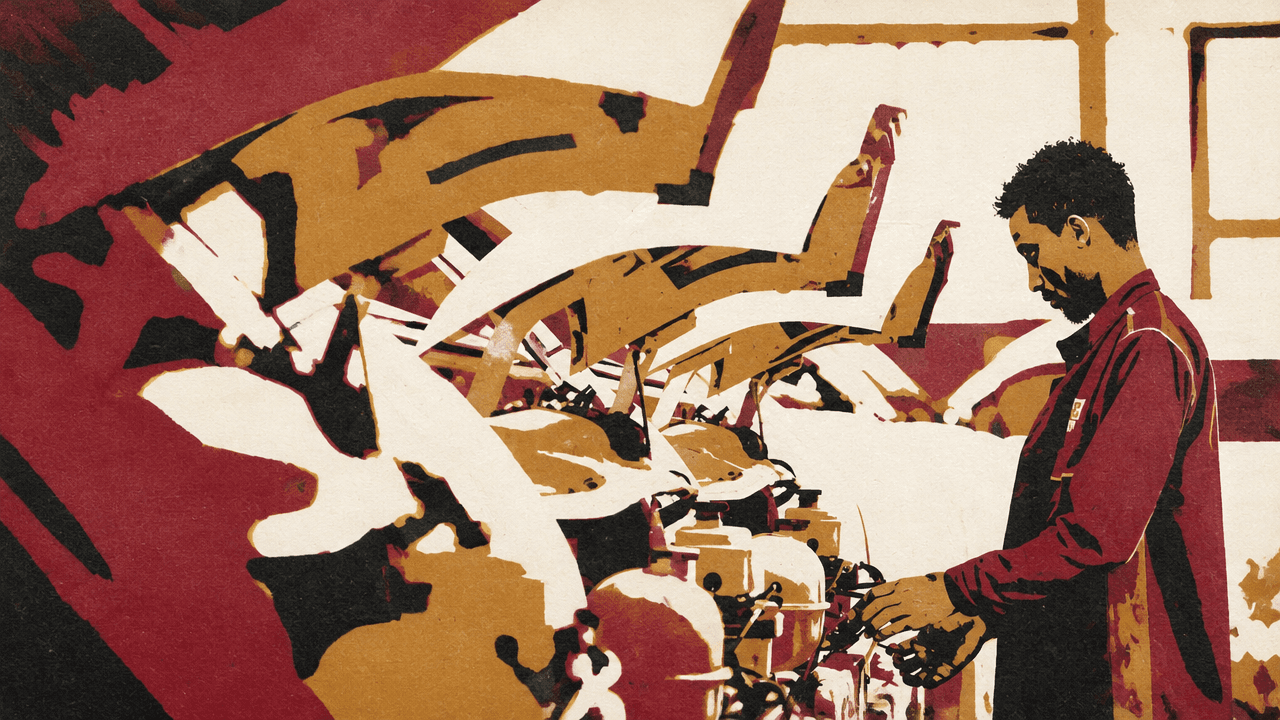
That incentive creates a route to local assembly, but it does not mean the vehicles are designed or manufactured entirely in Ethiopia. The parts for BKG’s minibuses come from China’s Nanjing Golden Dragon Bus Company. Ethiopian workers assemble them locally, including installing the main motor and battery. The tariff policy, as presented in the source, uses the cost of importing a finished vehicle to encourage companies to do more of the assembly inside the country.
The government has licensed about 17 EV assembly companies, but only one had begun operating: BKG Manufacturing, about 30 kilometers outside the capital. Its parent, Belayneh Kindie Group, began as an import-export business in 1991 and has expanded into areas including hotels, farms and construction. It entered vehicles in 2018 and has focused heavily on EVs for the past four years, said CEO Besufekad Shewaye.
The plant assembles minibuses, a form of shared transport commonly used in Addis Ababa. Bezuayehu Abera described vehicles arriving in semi-knocked-down form, with workers installing the main motor and battery. Chinese engineers initially worked alongside Ethiopian staff. A factory representative said that by a later visit Ethiopian employees had been trained and were handling every process themselves. Shewaye said BKG recruits recent university graduates, trains them in the field and integrates them into operations rather than hiring only experienced specialists.
The minibus focus connects the factory’s output to a transport system in which many people do not own cars. The city administration owns the large buses, while individual operators provide minibus services. BKG sells minibuses to private drivers and companies, but the Addis Ababa administration is its largest single buyer. Shewaye said the company had supplied the city with 100 twelve-meter electric buses and about 150 to 170 minibuses over the past two to three years.
That mix of buyers matters to the assembly effort. The city provides a large institutional customer for buses, while private drivers and companies also buy minibuses for shared transport. The source describes local assembly as a way to supply vehicles for those uses and train workers, as well as to benefit from the lower tariff on imported kits. It does not establish that the arrangement has yet produced a large domestic car industry.
BKG’s existing plant builds about one vehicle a day. The company is working on another plant for passenger cars, with assembly expected to begin in 2027. A factory representative said the new facility could eventually produce up to 10,000 vehicles a year. That is a stated future capacity, not current output.
The 2033 target depends on more buyers, vehicles and chargers
Ethiopia’s 2025 climate plan sets a goal of reaching 500,000 electric vehicles and 2,176 charging stations by 2033. The plan is a substantial expansion from the current public charging network of around 200 stations. It also depends on vehicles becoming available to many more buyers.
The price of an EV is a major limit. The figures shown in the source put a small model such as the BYD Seagull at about $23,000 in Ethiopia and average annual income per person below $1,000. Low running costs do not remove the large upfront cost. A driver may spend much less on electricity than on fuel after switching, but that saving comes after buying a vehicle priced many times above the stated average annual income.
The figures on adoption describe a narrow market, not widespread car ownership. Only 13 people out of 1,000 own cars in Ethiopia, compared with an African average of 73. The more-than-60-percent electric share of new registrations in Addis Ababa in 2024, the government’s 2025 estimate of more than 100,000 EVs on the road, and the separate pre-ban estimate of around 30,000 measure different things and periods. Together, they point to a rapid change in the vehicles entering the market, while Rathi’s caveat remains relevant: the government fleet totals have not been independently assessed.
Supply is another constraint. BKG’s planned passenger-car plant could eventually produce up to 10,000 vehicles a year, according to a factory representative, but assembly is expected to begin in 2027. That stated capacity is a future figure, not current production. The 2033 target will require growth beyond the output and operating capacity described at BKG.
The policy has moved the market quickly, but the next phase asks whether more vehicles can be supplied, whether prices can reach more buyers, and whether charging can keep pace. Cheap electricity, tariff incentives and purchases by the city support the transition; the targets make clear how much remains to be built.
Regional instability reinforces the fuel question
In September 2026, fighting broke out again in the northern Tigray region, almost four years after a peace deal was signed to end a deadly civil war between the government and the Tigray People’s Liberation Front. Ethiopia accused Eritrea, Egypt and Sudan of supporting the rebels; all three denied it. The source also links Ethiopia’s regional isolation to the Grand Ethiopian Renaissance Dam, which Egypt and Sudan opposed.
Prime Minister Abiy Ahmed has made access to the Red Sea a national priority, fueling speculation about the future of Eritrea’s port of Assab. The source places these tensions alongside volatile energy markets: crude prices rose sharply, with reported increases of 40 to 50 percent, and EV sales in developing countries were rising faster than before the Iran war began. These developments add context to the appeal of reducing oil dependence, but Ethiopia’s import ban came in 2024.
Ethiopia is continuing to expand hydropower generation. The Koysha project is under construction and is due by the end of the decade. In 2027, Addis Ababa is scheduled to host the UN Climate Summit, where the government hopes to show what an electric-vehicle transition can look like from the perspective of a developing country.
The approach is difficult to copy: the source points to Ethiopia’s Nile hydropower, relatively small car market and acute fuel crisis as conditions that helped it move quickly. Whether the bet pays off depends on unresolved constraints already visible in the figures: EV prices remain far beyond average annual income, the grid is uneven, public charging is limited, and current assembly capacity falls well short of the 2033 vehicle target.