Burnham’s Break With Thatcherism Runs Up Against Britain’s Debt
 Andy BurnhamPhilip AldrickMargaret Thatcher
 Lizzy Burden
 James Woolcock
 Arthur Scargill
 Victoria WakelyHelen ThomasBloomberg OriginalsFriday, October 2, 20265 min read
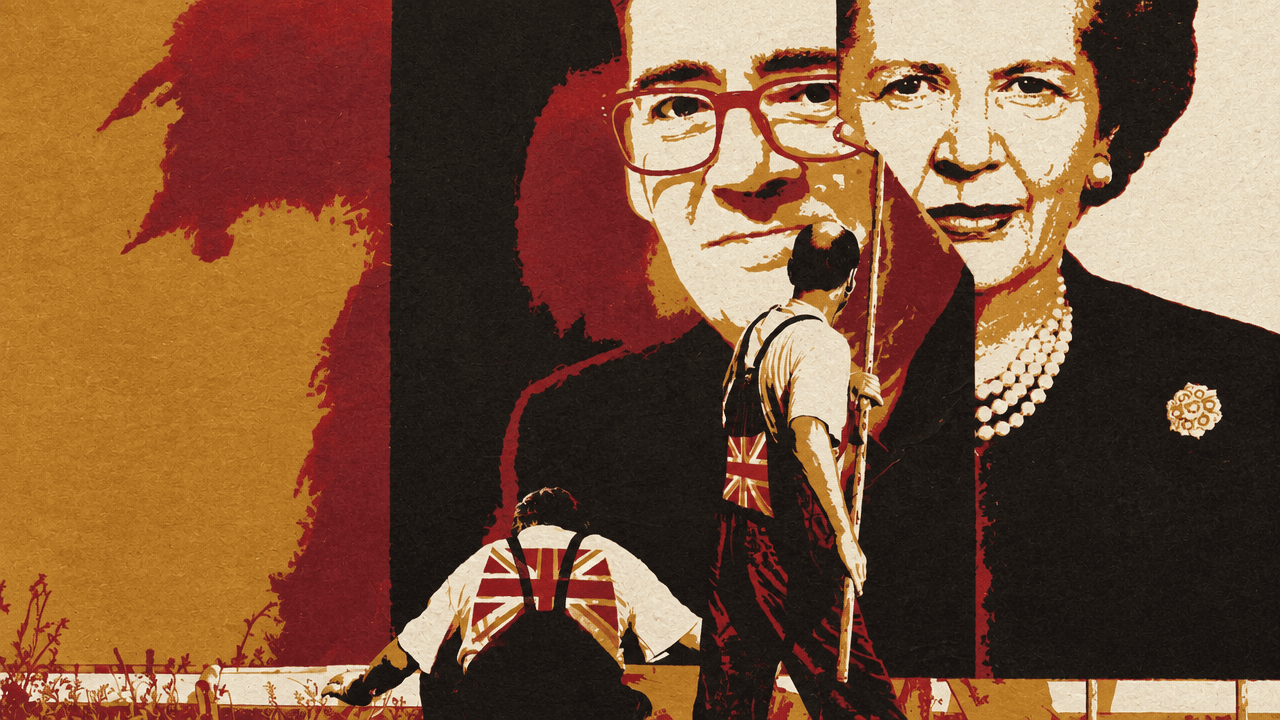
Andy Burnham’s pledge to reverse Margaret Thatcher’s economic legacy runs up against a constraint Thatcher did not face on the same scale: Britain’s higher debt and borrowing costs. Bloomberg’s analysis finds that Burnham’s push for more local power and public control of essential services would require choices about what to take back—and how to pay for it. Analysts Adrian Wooldridge, Philip Aldrick and Victoria Wakely argue that a viable break with Thatcherism would depend on expanding the state without losing the bond market’s confidence.
The bond market is Burnham’s constraint
Britain’s debate over Margaret Thatcher’s economic legacy turns on what the state should control—and what it can afford. Andy Burnham says the country should break with four decades of free-market orthodoxy, including what he calls Thatcher’s “ideological ban” on public ownership of water companies. But the government’s room to act is far tighter than it was when Thatcher took office.


Long-term UK borrowing costs have risen to their highest level since 1998. In the comparison shown, UK government borrowing costs are higher than those of the US, France, Italy and Germany. The government’s debt has also grown substantially as a share of the economy.
Victoria Wakely says debt-interest payments run to tens of billions of pounds a year—money that could otherwise go to services such as trains or transplants. The cost of supporting the country through Covid contributed to that burden. Philip Aldrick contrasts Thatcher’s “fiscal runway” with Burnham’s “helipad”: the bond market, rather than the unions, is now a major limit on government choices.


Aldrick says growth is weaker while demands on the state are rising. Wakely adds a political constraint: many people want better public services but are not necessarily prepared to pay more for them. If investors conclude that Burnham is borrowing irresponsibly, the cost of borrowing could rise further. Any break with Thatcherism therefore has to address not only what the state should do, but how to finance it.
Thatcher’s settlement answered one crisis and deepened regional divides
Thatcher’s program took shape amid a widely shared sense that Britain had become difficult to govern. In the 1970s, the country faced high inflation, powerful unions and repeated industrial disputes. Wakely says nearly 30 million working days were lost to disputes in 1979, the most since the 1926 general strike. Adrian Wooldridge says Britain’s appeal to the IMF for a bailout had made it a laughing stock.
Thatcher saw the unions as part of the problem. She said she was not declaring war on union leaders, but challenging their belief that government could be a “universal provider.” Her government pursued monetarism to bring down inflation by reducing the money supply, cut the top tax rate, strengthened central government and weakened local decision-making. The changes were fiercely contested: unemployment rose to about 11%, with three million people out of work, while anger at the government spread across the country.
The economic shift had uneven effects. Wakely describes a broad divide in which the Southeast did better than regions hit by rapid deindustrialization. Wooldridge says the northern manufacturing belt and many main-street businesses collapsed as the economy tilted toward the City of London and finance. Thatcher’s settlement changed not just who owned businesses, but which industries and regions stood to gain.
Privatization was central. Nationalized industries made up as much as 10% of the economy and employed nearly two million people; the public sector employed 7.9 million. Selling utilities such as British Gas, BT and electricity networks raised money for the Treasury and brought private investment into services that Wooldridge describes as run-down. The pitch to the public was to turn ordinary citizens into shareholders.
The fact that the companies largely remain private, and that unions have not regained their former power, has not settled the argument over privatization’s results. Aldrick says customers have faced higher prices while investment has failed to keep pace with need. He points to the backlash against private water companies amid sewage spills into rivers and seas. A displayed Guardian headline about a Thames Water finance chief quitting a £1.3 million-a-year role offered a specific example of the scrutiny facing utility management.
Manchesterism shifts power locally, but ownership choices carry different costs
Burnham’s political case is rooted in his nine years as mayor of Greater Manchester, where the region’s economy grew at twice the national rate. His approach, dubbed “Manchesterism,” starts with shifting power away from Westminster. Aldrick describes its premise as giving local leaders room to make decisions for their areas rather than deferring to central government.
That localist agenda would mark a break with Thatcherism, which Wooldridge characterizes as centralizing political power even as it privatized economic power. Burnham has pointed to Manchester’s bus network, brought back under public control, as an example of local authority over essential services. Aldrick says that bringing second-tier cities closer to London’s productivity could support faster growth and better living standards.
On utilities, “public control” could mean several things: tighter regulation, public stakes in private firms, so-called golden shares, or full public ownership. Burnham has called water a symbol of what has gone wrong with Britain, and said companies that fail to serve the public interest could face a loss of control or public ownership. Wakely expects greater control or regulation of utilities and industries such as steel to be more likely than outright nationalization.
The difference between water and rail makes the practical test clear. Aldrick says nationalizing water would require billions of pounds of investment, even if the government acquired Thames Water for free: a public owner would still have to fund work now being provided by private investors. Rail services could be transferred more cheaply. The government could take over as operating contracts expire, Aldrick says, because operators hold service contracts rather than infrastructure that the state would need to buy.
Burnham’s wider agenda includes a domestic industrial strategy and reindustrialization, alongside more devolution, social-care reform, possible higher taxes on the well-off and perhaps a reversal of Brexit. Wakely says the available resources are limited, and the cost of funding major changes through taxes, borrowing or both is difficult to imagine. For Wooldridge, Burnham would have to show he can bring debt and spending under control as well as expand the state’s role.
A viable break means more than a return to the 1970s
Wooldridge draws a distinction between nostalgia and a new governing philosophy. A simple return to the 1970s, he argues, would be “dead on arrival.” A more active state, operating in selected areas after the neoliberal period, could instead form the basis of a viable alternative.
The test is whether Burnham can match greater local power and public control with choices that fit the country’s fiscal limits. Water ownership could bring substantial investment obligations; taking over rail services as contracts expire is a different proposition. Reversing Thatcher’s legacy would mean deciding where public authority should return—and showing how those decisions can be paid for.