The Highest Loop Is People Creating the Next Loop
In The Highest Loop, Shawn Wang argues that AI engineers need to move between levels of work, from debugging tokens and tool use to improving larger goals and automations. He extends that stack to human organization, from small teams to wider communities, and casts AI Engineer World’s Fair as a place where builders can decide what processes to create next. For Wang, the highest loop is the one that brings people together to make new loops.
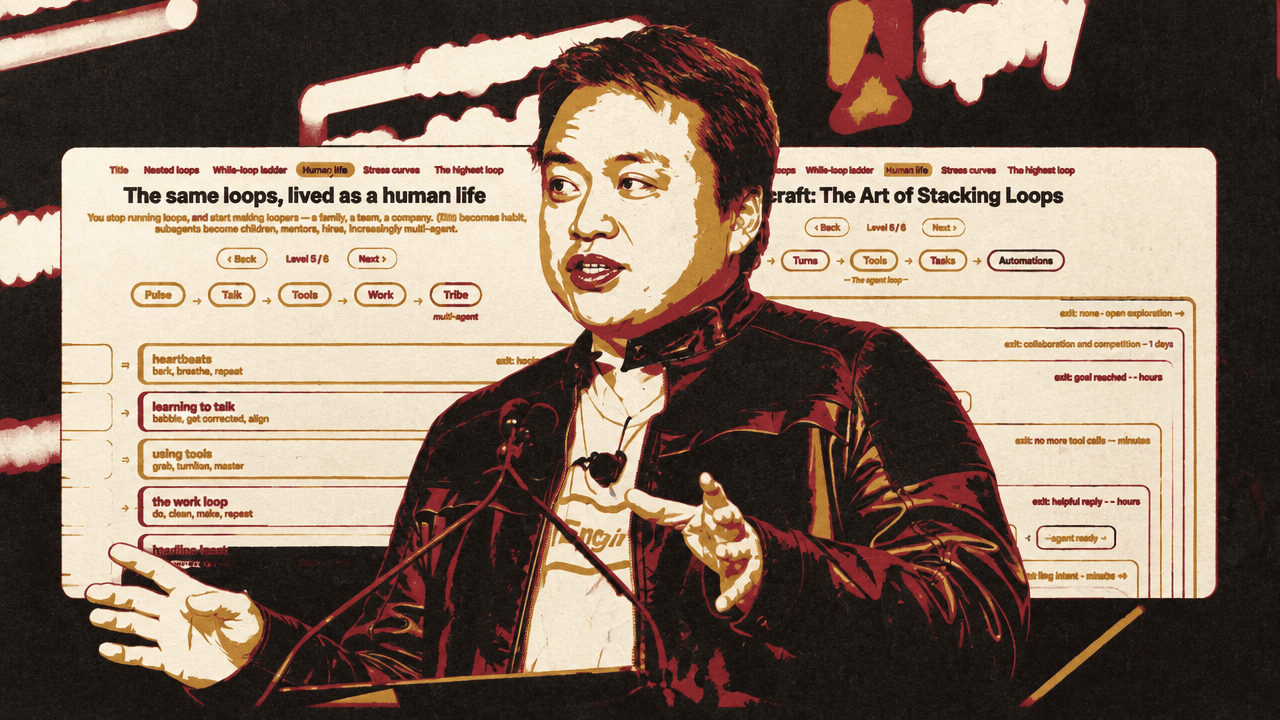
AI engineering means choosing the right loop
For Shawn Wang, AI engineering increasingly means working across nested loops: generating tokens, holding a chat, using tools, pursuing goals and running automations. Each level changes what a system can do—and what an engineer needs to understand, tune or debug.
The practical skill is knowing when to move between levels. If the current abstraction is limiting productivity or the ability to scale inference, move up a loop and work at the level of a broader objective or process. If something breaks, move down to find the reliability problem or bug. The point is not to stay at the highest level, but to choose the level that fits the work and recognize when that choice needs to change.
His simplest model is a stack of while loops, each running until its own stopping condition. For example, when an agent is failing to complete a goal, an engineer can move down from the goal loop to inspect the agent’s turns, then down again to the chat or token loop. If the problem is not a bug but a limit on productivity or scale, the move is upward: work at the level of the larger goal or automation instead.
That framing also explains why AI engineering spans many kinds of work. Researchers, engineers, leaders and founders may be working on different loops, or blocked at different ones. Wang said attendees should route themselves toward the level relevant to their problem rather than expect a conference program to narrow its range. A broad set of sessions reflects the range of loops people are trying to build and improve; attendees have to work out which one speaks to their current challenge.
The same stack appears in human life
Wang maps the technical progression onto human development: a heartbeat, learning to talk, learning to use tools, then working. From there, people work in teams and small groups. He points to “tiny teams” as an increasingly important unit, then widens the frame to families, countries, companies and, ultimately, human civilization.
The analogy is not just a way to explain software. Wang said the practices developed through coding are crossing into human life. The question is how people organize themselves at each scale, and how collective intelligence contributes to the larger project of what humanity is building. The loops are not only individual routines: people coordinate with others, form groups and take part in projects larger than any one team.
He also sees AI moving beyond its initial concentration in coding. The conference’s vertical tracks in healthcare, finance and go-to-market, alongside a forward-deployed engineering track, are intended to examine that diffusion into other domains. Agents working in one domain, he said, are generalizing. The significance, in his account, is not only that AI is being applied in new sectors, but that the work of engineering and organizing those systems is spreading with it.
The highest loop is the one that creates loops
Wang’s answer to the question of the “highest loop” is people gathering to work out what the next loop should be:
The highest loop is where humans come together to figure out what the next loop is, right? The loop that makes loops.
A team can establish a working process, but a gathering of builders can compare approaches, compete and collaborate, then carry what they learn back into their teams and personal workflows.
That is Wang’s rationale for organizing AI Engineer Summits in multiple cities and treating the World’s Fair as a “summit of summits.” He named summits in New York, Paris and Singapore, as well as Melbourne and Miami, and invited people to organize them in their own countries as partners. The World’s Fair sits above those local gatherings in his metaphor: a place where builders meet across projects and decide what loops to create or improve next.
He also connected the conference’s scale to a practical organizing problem: when people buy tickets. The on-screen chart reports sales-pace Gini coefficients of 0.038 in 2023, 0.505 in 2024, 0.730 in 2025 and 0.707 in 2026. Those figures describe the concentration of sales pace; they do not, by themselves, explain why that pattern occurred. Wang’s explanation was that people bought late: he said organizers had asked attendees to purchase earlier, had aimed for 6,000 attendees, and crossed that target to reach 7,000 on the day of his remarks. His appeal was to gather earlier rather than leave organizers with the late rush he described.
Wang’s closing charge is to develop a generative process for creating loops, then propagate it into teams, personal workflows and daily life. In this account, the conference sits at the top of that stack because it brings people together to work out what comes next.