GLM-5.2-Class Intelligence Could Reach a Single RTX 5090 by 2028
Ahmad Osman, founder of Osmantic, argues that rapid gains in model efficiency are bringing recently frontier-level capabilities onto hardware individuals and businesses can own. Citing the falling parameter requirements for comparable performance, he forecasts that GLM-5.2-class intelligence could run on a 32GB RTX 5090-class GPU by late 2027 or early 2028. For Osman, the consequence is strategic as well as technical: a GPU’s value rises as better open models become deployable locally, giving operators control over their models and access.
Frontier capability is moving into hardware people can own
? ahmad-osman forecasts that, by late 2027 or early 2028, GLM-5.2-class intelligence could run on a single RTX 5090-class GPU with 32GB of VRAM. His estimate is roughly 18 months from the point of the presentation, and he calls it conservative.
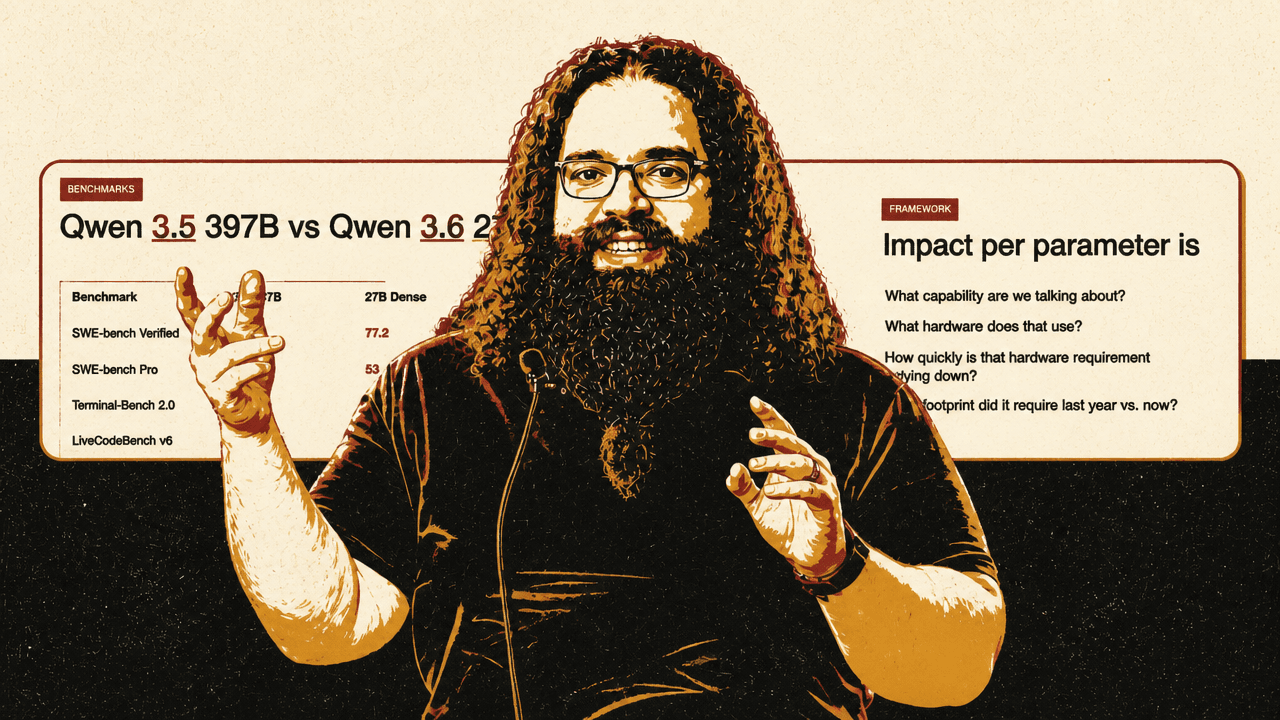
The premise is not that open-weight models will permanently eliminate the gap to the most advanced proprietary systems. Osman expects a gap to remain. His claim is that the gap is narrowing while the hardware footprint required for a given level of capability falls quickly. What matters, he argues, is not parameter count alone but “impact per parameter”: what a model can do, what hardware it needed last year versus today, and how quickly that requirement is declining.
He frames this as a second curve alongside the familiar scaling story of bigger models and bigger clusters. Large-scale training may still push the frontier forward, but similar capability bands are repeatedly appearing in systems with smaller active footprints—systems an individual or organization can deploy, own, and modify.
It’s not that small models are beating big models. It’s that newer and more efficient models are beating older, less efficient ones.
That distinction is central to his argument. A small current model is not necessarily surpassing today’s largest frontier model. Rather, successive generations are displacing models that only recently required far more compute. Osman recalls running Llama 2 on an RTX 3090; he now says a 27-billion-parameter Qwen model can outperform Llama 3 405B, a model with more than 400 billion parameters, within roughly a year and a half.
The effect is not limited to benchmark gains, in his telling. A year earlier, he says, no local model could reliably operate within Claude Code. When GLM-4.5 arrived in late July, its Air variant needed at least four RTX 3090s or an RTX Pro 6000. The local footprint has since fallen to a single RTX 3090 or RTX 5090, while capability has improved. Context windows have expanded as well: models that struggled to sustain more than 4,000 tokens have given way to locally run systems with million-token context.
Osman attributes the trend to deliberate research rather than chance: improved training and post-training, architectural changes, efficiency work, and what he calls “architecture hacks” that compound over time.
The compression rate changes what a GPU purchase means
? ahmad-osman cites what Nature Machine Intelligence calls the “densing law” of large language models: across six datasets of open-source base LLMs, the number of parameters needed to achieve the same benchmark score has been falling by roughly 50% every 3.5 months. He notes that the result can differ depending on whether the count is dense parameters or activated parameters, but treats the direction as clear: more intelligence is arriving in smaller models.
His forecast applies that rate to GLM-5.2, which he describes as having 744 billion total parameters and 40 billion active parameters. His calculation reduces the 744B total-parameter count to a hypothetical 27B dense capability-equivalent model, then uses that trajectory to argue that equivalent intelligence could be practical on 32GB RTX 5090-class hardware.
The implied reduction is 27.6-fold: 744 ÷ 27 = 27.6. Osman translates that into roughly 4.8 halvings; at one halving every 3.5 months, that is about 17 months. Starting from mid-2026, the directional forecast points to late 2027.
He says recent experience gives him confidence in that pace. Earlier in the year, he had predicted that Opus 4.5-quality performance would become available locally on a single RTX Pro 6000. He says that result arrived by March.
This is why Osman regards hardware differently from a conventional depreciating asset. A GPU’s physical specifications do not change after purchase, but the models that fit on it can. The relevant question is not only what a DGX Station can run on delivery day, but what it will run as model efficiency advances.
What will a DGX Station be able to run in 3, 6, 12, and 18 months from now?
Osman points to his own decision not to sell his RTX 3090s despite owning substantial hardware. He is more interested in the tasks they may support in a year or two than in their present resale value. He says RTX 3090s built on NVIDIA’s 2020 Ampere architecture still sell above their original MSRP and remain useful for many workloads. By the same logic, he asks what a deskside DGX Station based on Blackwell hardware may run after subsequent model improvements arrive.
Efficiency comes from training, sparsity, and post-training
For ? ahmad-osman, compression is not simply a matter of mixture-of-experts architectures activating fewer weights per token. He points to Llama 3’s improvement over Llama 2 at both 8B and 70B sizes, which his presentation attributes to stronger training recipes. It also points to Gemma 2 27B, positioned as competitive with models more than twice its size, and Qwen2.5-72B, reported as performing at a top tier against Llama 3.1 405B despite being a fraction of its size.
Better data, training recipes, tokenizers, post-training, and evaluation loops all contribute in this account. Osman’s Llama 2 example illustrates the operational result: he says the 70B model once took eight RTX 3090s to load, while those same eight GPUs could now run roughly 15 parallel agents using Qwen 3.5 27B.
Sparse architectures create a second path. DeepSeek-R1 had roughly 671B total parameters but 37B active parameters, and Osman calls it a major moment because it made open-weight reasoning runnable at home, even if it initially required a powerful server. The later DeepSeek-R1 release, he says, showed that additional post-training could improve results on the same underlying checkpoint.
GPT-oss-120b represented a more compact deployment profile: 116.8B total parameters, 5.1B active parameters, and a design intended for a single 80GB GPU. Osman describes it as one of the first open-source models able to perform tool calling successfully. In the comparison he presents, DeepSeek-R1-0528 scored 81.0 on GPQA Diamond with 37B active parameters, while GPT-oss-120b scored 80.1 with 5.1B active parameters.
The practical implication is not that total parameters no longer matter. Osman treats both total size and active footprint as relevant to local operation. But a model that retains strong reasoning, tool use, or agentic performance with a smaller full model or a smaller active footprint becomes easier to deploy on hardware its user controls.
The Qwen comparison shows both the strength and limits of the claim
? ahmad-osman offers a closely matched Qwen comparison as his most direct evidence. Qwen3.5-397B-A17B is a 397B total-parameter mixture-of-experts model with 17B activated parameters; Qwen3.6-27B is a 27B dense model.
The total-parameter difference is roughly 14.7x. Yet the newer 27B dense model performs similarly or better on most of the benchmarks Osman shows. Its 27B active footprint is also only about 40% higher than the larger model’s 17B active footprint. That makes the inference-compute difference narrower than the headline total sizes suggest, even as the overall model footprint and hardware requirements remain substantially different.
| Benchmark | Qwen 3.5 397B-A17B | Qwen 3.6 27B dense |
|---|---|---|
| SWE-bench Verified | 76.2 | 77.2 |
| SWE-bench Pro | 50.9 | 53.5 |
| Terminal-Bench 2.0 | 52.5 | 59.3 |
| LiveCodeBench V6 | 83.6 | 83.9 |
| AIME26 | 93.3 | 94.1 |
| MMLU-Pro | 87.8 | 86.2 |
| GPQA Diamond | 86.4 | 87.5 |
The counterexample matters. MMLU-Pro declines from 87.8 to 86.2. And the comparison is not a case of a 27B active model replacing a 17B active model at the same inference footprint; Osman explicitly notes the active-parameter difference. Still, he sees the overall result as significant: post-training and iteration produced comparable or better results in a model with around one-fifteenth of the total parameter count, over only two or three months.
That is the evidence behind his larger question: how long before open weights offer the quality of a recently released frontier system on hardware that an operator can control rather than a remote service that may be changed, withdrawn, or decline requests.
Owning the stack is the economic and strategic conclusion
? ahmad-osman makes the case for local AI as a case for control, not only lower VRAM requirements. He asks why consumers, small and mid-sized businesses, and enterprises would rely exclusively on cloud providers when they could own the hardware and models, retain access to them, and optimize them for specific workloads.
He contrasts buying hardware with paying for access to remote data centers through subscriptions and what he characterizes as subsidized token pricing. In his view, those subsidies may disappear, cloud systems may impose increasing limitations, and an owned model stack can be adapted later to a particular use case. Local ownership, he argues, means that access to the model cannot simply be taken away from its operator.
He offers GPT-4o-quality performance running on an iPhone as evidence of how far that local trajectory has already reached. That capability, he says, once required data-center service. For individuals, he describes ODS as a way to support local access; for the broader ecosystem, he places particular weight on enterprises.
Open-source AI needs enterprise demand to thrive, Osman argues. Organizations that use cloud services are helping support data-center construction. If more of that demand shifts toward operators that own their hardware and run their stack end to end, he believes it will strengthen incentives for open-model providers to release models and for the ecosystem to develop licenses that let open source flourish.
He reduces the decision to a hardware-buying question: if a 32GB RTX 5090 may run GLM-5.2-equivalent intelligence within 18 months, should you buy a GPU?