Ramp’s Finance Model Edges Opus on Spreadsheet Questions at Lower Latency
Ramp Labs is building applied research into Ramp’s finance software rather than waiting for frontier models to improve, its lead, Alexander Shevchenko, argues. The team has put three approaches into or toward production: a post-trained model that narrowly beat Opus 4.6 on financial question answering, precomputed context for tasks such as month-end close, and large agent swarms for security testing. Shevchenko’s case is that targeted work on latency, context and cost can make general models more useful for specific finance tasks.
Frontier models improve the economics, but not every product problem
? alexander-shevchenko leads Ramp Labs, an experimental research team inside the finance software company. Its premise is not that frontier models have stopped improving. Shevchenko says Ramp’s LLM use cases grew 123% over the past year, while the cost of several prominent features fell: approval intelligence by 76%, underwriting by 90%, and the vendor mailbox by 81%. Better, faster, cheaper models let Ramp deliver the same accuracy at lower unit cost.
That pattern might suggest waiting for the next model release. Shevchenko’s counterargument is that application companies have always had to work with the capabilities available. In 2023, building an agent around GPT-4 meant tight guardrails, carefully tuned prompts, and limited context. Models did not reliably recover when they went off course, and even synonyms could change their behavior. Ramp shipped agents anyway, including Ramp Tour Guide, because finance teams needed the tools then.
By 2026, agents can take on broader tasks with access to more context and tools, Shevchenko says. But easier agent-building does not eliminate the opportunity to improve the experience by working below the application layer. Ramp Labs’ work takes three forms: post-training a specialist model, preparing context before a task begins, and coordinating many agents to search large problem spaces.
A specialist model handles the slowest part of spreadsheet work
Ramp Sheets launched in November 2025 as a general-purpose spreadsheet agent. Ramp saw a chance to extend its underlying system to other finance workflows, but first examined where the agent was slow. When users supplied many spreadsheets and asked it to build a discounted cash flow model or explore a financial scenario, a frontier model such as Opus 4.6 spent substantial time planning and inspecting the available files.
Rather than replace the frontier model, Ramp Labs created a faster component for the retrieval work. In the resulting setup, a frontier model acts as the orchestrator: it plans, reasons, and edits the sheet. FastAsk, a post-trained Qwen 3.5-35B-A3B model, answers questions about the spreadsheet context and hands the information back to the orchestrator.
Ramp worked with Prime Intellect to post-train the model for financial question answering. On the exact-task accuracy comparison shown in the presentation, FastAsk scored 68.25%, against 67.88% for Claude Opus 4.6. The chart labels the result “+14 pts at Haiku-level speed”; its displayed scores establish a narrow lead over Opus, not a 14-point gap over Opus. Shevchenko says the model was sent to production as part of Ramp Sheets.
The design is a division of labor, not a claim that a smaller model can replace a frontier model across the board: a fast specialist handles a bounded, repetitive part of the task, while the larger model remains responsible for planning and execution.
Precomputed context turns month-end close into a prepared task
A second line of work uses KV-cache “cartridges” to prepare information before an agent needs it. Shevchenko says the technique can compress 20 to 30 times more context into a model’s KV cache offline, then make that context available to an agent.
Month-end close is a natural fit because the timing and the documents are predictable. A finance professional may need the ledger, aging report, and open invoices to reconcile accounts at the start of the month. Without a cartridge, the agent must retrieve and interpret those materials as the work begins. With one, Ramp can assemble the context overnight; when the user opens the agent, it has the relevant information ready.
Shevchenko describes cartridges as a lower-lift alternative to post-training: they do not require verifiers or rubrics, and their self-play process is more generalizable. The approach is still under exploration. Model providers may eventually offer similar capabilities through their APIs as they pursue continuous learning. Ramp’s reason to work on it now is to develop practical knowledge about applying the techniques, so it can use them effectively if they become available as a service.
A swarm can search broadly, then filter its own findings
Ramp’s third example is agentic map-reduce: assigning work across many agents, then consolidating their results. Ramp used its cloud agent, Ramp Inspect, to coordinate roughly 10,000 parallel agents in a penetration test. The agents searched for vulnerabilities, created tickets, merged duplicates, and tried to reproduce candidate bugs adversarially.
The funnel in Shevchenko’s presentation narrows about 10,000 sessions to roughly 6,000 tickets, then about 3,000 after duplicate merging, before adversarial reproduction left seven high-severity findings. Ramp says it patched all seven.
One example required tracing how components interacted rather than finding a single unsafe component. An email could exploit a Lua script injection in Ramp’s renderer: the email closed a Lua string early and caused code to run. The presentation says the swarm followed the flow across components and proved the exploit in its sandbox before filing the issue.
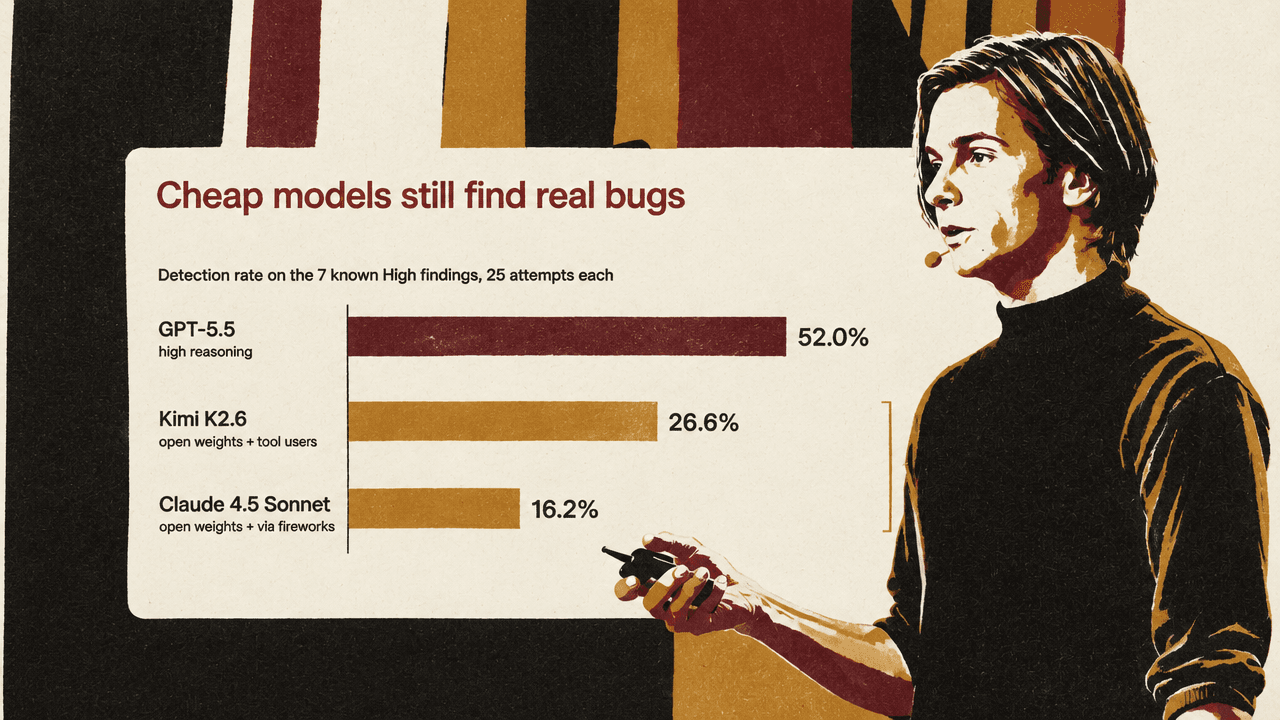
The process runs automatically, Shevchenko says. Failed passes are filtered out; their cost is tokens rather than investigators’ time. The economics also depend on model choice. In tests against the seven known high-severity findings, with 25 attempts per model, GPT-5.5 High reasoning detected findings at a 52% rate. Kimi K2.6, an open-weight model run through Fireworks, reached 36.6%; DeepSeek V4 Pro through Fireworks reached 20.6%. Shevchenko says the open-weight models can cost up to five times less per token. In a swarm, he argues, lower detection per attempt can still be worthwhile because the cheaper tokens allow more attempts.
Research also targets the cost and routing of everyday AI use
Across these projects, Ramp Labs is pursuing lower latency and lower token costs—the two forms of savings Shevchenko connects to Ramp’s focus on saving customers time and money. He points to Token Spend Management, which gives companies a view of LLM use beyond API keys or individual users, including accounting categories, tax-credit analysis, and semantic classification of what the models are being used for.
Ramp Router applies the same focus to inference. Shevchenko says it uses routing strategies, including NVIDIA SwitchYard and smart flex offloading, to improve latency and token costs. The presentation’s slide reports a 4.15-times median multiplier between the most and least cost-efficient LLM requests per token, and displays “42% lower” alongside a chart of cost impact over time for Ramp Router. Shevchenko describes the router’s strategies as targeting both latency and cost.
Other Ramp Labs work includes Portal, which transfers learnings from one post-training run to other versions or model families, and self-improving monitoring, which uses models to create and update Datadog monitors as alerts arrive. These projects extend the same approach: work on a specific bottleneck, rather than assume that waiting for a more capable general model will resolve it. Frontier progress lowers the cost of building with AI; applied research is Ramp’s attempt to make those capabilities fit finance work more closely.