When Execution Gets Cheap, Ownership and Judgment Set the Bar
Jason Liu of OpenAI’s developer experience team argues that when AI makes execution cheap, ambition is less about producing more than about deciding what is worth making. In his account, the risks of slop, weakened judgment and becoming a passive observer of AI-generated work are best met by taking responsibility for what ships, learning to describe what good work looks like, and using AI to explore fields people once set aside.
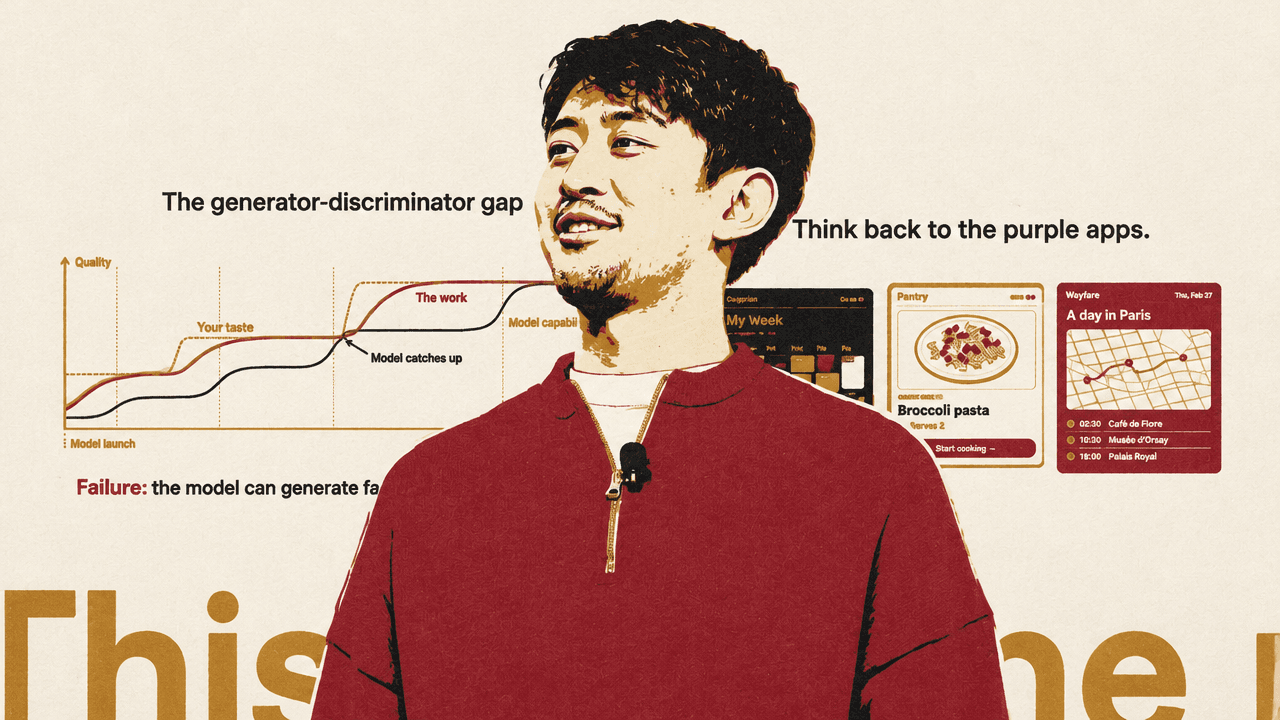
In Liu’s analogy, the evaluator limits what the generator can improve
Jason Liu frames ambition in AI as a question of what people choose to make, not how many tokens or agents they use. In a world where execution is becoming cheap, he argues, the harder limits are whether people take ownership of the work, can describe what good looks like, and are curious enough to pursue work beyond their current field.
His account of the fear that AI will weaken critical thinking turns on a machine-learning analogy: the generator–discriminator gap. One model produces outputs; another evaluates them. Liu says that if the evaluator cannot tell better from worse, it cannot guide the generator toward improvement. He places people in that evaluator role. As models become more capable, their outputs may approach a person’s own taste, making it harder to identify how a result could improve. In Liu’s terms, the failure is not simply that a model can produce more than a person can make; it is that a person may not be able to judge whether the model’s output is good or how to make it better.
That claim gives a practical meaning to the concern that AI will weaken critical thinking. Liu’s answer is that judgment remains necessary—and can be developed. If a person cannot explain why one result works better than another, having more generated options does not resolve the problem. He argues that people need to “learn again” and “think again”: to build the language and experience that let them evaluate what a model produces.
This is also why Liu resists treating increased production as ambition in itself. He joined OpenAI’s developer experience team in March, and says the launch of products such as the Codex app shifted his sense of the work from developer experience toward “everything experience.” AI, he said, could make it possible for everyone to make things. The audience for thinking about ambition, in his view, therefore extends beyond professional developers.
The question is not only what tools can do, but what people want to make with them—and whether they remain involved in deciding what is worth making.
More output is not the same as less responsibility
Liu expects easier production to create more low-quality work. He compares that possibility with the arrival of photography. Painters whose work depended on recreating images had reason to feel threatened by the camera, he says. But photography did not remain only a faster way to reproduce images: it became an art form, while film and other mediums opened up further possibilities.
Liu invokes Walter Benjamin’s description of photography as freeing the hand from some artistic functions and shifting them to the eye and the voice. He sees a parallel in AI tools that can take direction through voice. A person can ask for a wider shot or describe a feeling, while tools or other people help carry out the work. The means of execution change; the need to form and direct a vision does not disappear.
His camera-roll example makes room for the waste that comes with access. Liu says he may have a thousand photos he will never look at, and allows that they may count as slop. But he grew up in a place where his family could not afford a camera, so he has few childhood photos. He would have wanted access to a camera even if it meant taking many forgettable pictures, because it might also have preserved a few important moments.
For Liu, the camera, paintbrush, clay and code are mediums. The more consequential distinction is whether someone thinks of themselves only as a technician carrying out a task, or as an artist using a medium to make something. The first framing can make a newly automated technique look like the loss of a skill; the second leaves open what a person might express through the available tools.
That does not remove responsibility from the person directing the work. Liu compares a product made with a power tool to a table: people do not ordinarily say the toolmaker made it. A film remains the director’s movie even if a thousand people worked on set. In open source, he says, core maintainers remain responsible for quality despite the contributions of many people—or agents.
He calls the risk “self-erasure”: becoming a passive observer of work a system produces instead of an active participant in its creation. A person might merge a thousand pull requests a day, he says; the difference that matters is whether they care about the work. Ownership, in this account, is not personally performing every step. It is staying involved in decisions about quality and remaining responsible for what ships.
The medicine for slop is really just the fact that you really need to believe that you own this work.
For engineers, Liu describes that involvement in concrete terms: use the product, notice where it breaks or feels wrong, decide whether it needs another pass, and iterate. He says strong examples people see online are often not one-shot outputs. At OpenAI, he describes people working on the Codex app as talking with users about what broke or felt strange, then addressing those issues. He also describes the product team as bringing work back together when things slip, guided by a sense of ownership over quality.
Taste becomes useful when it can name what needs to change
Ownership makes evaluation unavoidable: if a person is responsible for the result, how do they know when it is good enough? Liu’s answer is that easier execution does not eliminate the effort of creation. It makes the ability to identify and describe what is happening more important.
He recalls beginning art school without knowing how to develop film; he could use an iPhone instead. But he still had to understand design: space, value, shape and texture. When he did not understand negative space, he made sketches and explored it. He describes a similar process in software: make different applications, then think about why one feels right and another does not.
In art school, Liu often knew that he disliked what he had made without being able to produce the version he wanted. His taste and judgment exceeded his skill. Repeating “make it pop” would not close that gap, he says. He had to develop language for what he was seeing.
This is why he dislikes the slogan “taste is the moat” when it is left undefined. His own definition of taste is the ability to describe what you like and predict what other people will like. That involves building a model of the world and of other people. He quotes Wittgenstein’s line, “The limits of my language mean the limits of my world,” to express how language can shape what someone is able to notice and pursue.
A software example shows how a term can give someone a new way to inspect a problem. Liu describes seeing a post by Steve Ruiz that said, “find all of the implicit state machines in my app.” Liu had to look up what the phrase meant. He says commenters described their apps as about 20 percent faster afterward. For Liu, the episode illustrates how learning a concept can help someone recognize a problem and make a more specific request.
Liu’s own work building software led him to study typography, information hierarchy, motion and interaction design. He found websites ugly but initially did not know how to explain why. He spent time learning terms such as kerning, tracking, leading and type scale, then studied how information is presented, how movement feels, and what makes an interaction feel good. The vocabulary gave him more specific ways to distinguish among outputs.
He contrasts that with a set of purple app interfaces—a calendar, a recipe app and a travel itinerary. In his view, their makers could not see what was wrong and thought the results were acceptable. The problem, as he presents it, is not simply imperfect generation. It is the absence of a point of view or language that would let someone identify what should improve.
Judgment grows through contact with work beyond the screen
For Liu, developing taste means encountering more of the things someone might want to make and asking what works. Someone building games can play games and consider what feels fun, which animations feel good, and what stories matter. Someone building tools can spend time with other applications. The question is not only whether something appeals, but whether a person can describe why.
His 3D-printing projects show how looking elsewhere can change what he asks of a model. At first, he says, AI-assisted designs looked like “rectangles glued together.” Repeating “make it more beautiful” was frustrating. He began looking at sports cars and industrial design, and visiting stores to understand what made a curve look good. He says his designs became more beautiful by his own judgment.
He describes a related shift in his thinking about marketing. He had told the marketing team to use the Codex app more, but realized he was not watching more advertisements himself. Watching more films gave him stories to think about. Liu says that asking why things feel good has made him think more, not less, and has enriched his view of the world.
His recommendation for teams follows from that emphasis on experience: if AI is making a team more productive, he says, the team should make space to explore what others are making and experience the world. People who make strong work, he adds, can inspire others; exploration is how a team can return with a point of view. The advice applies not just to individual taste but to how teams organize time. If the expectation is that people will use new capabilities to make better work, Liu argues, they need time to encounter examples, try tools, and develop the judgment to say what they want to make.
That same curiosity can carry software judgment into fields people set aside. Liu asks software engineers what they gave up to pursue software, and where else they might use the experience they have developed.
He points to creative work that has crossed disciplines, including Charles and Ray Eames’s work across furniture, houses, films and toys, and the varied pursuits of Leonardo da Vinci and Michelangelo. Liu argues that creative work has often crossed fields: Michelangelo was a sculptor, painter, architect and poet, while the Eameses worked across design and media. Technical fields, by contrast, have become harder to enter because they require so much knowledge; one person cannot simply acquire several PhDs without a substantial investment of time.
Yet cross-disciplinary work can change fields, Liu says. He names Max Delbrück, a physicist who helped found molecular biology; Eric Lander, a mathematician who helped lead the Human Genome Project; and John Hopfield, who used the mathematics of magnets to describe neural networks. For Liu, these examples make the cost of disciplinary barriers visible: crossing fields may be difficult, but bringing one field’s methods into another can open up new work.
He also points to OpenAI’s chip project, where engineers used AI to design a chip intended to make AI faster. Other examples he gives include a machine-learning consultant applying molecular biology to help his dog, and a public servant in Hokkaido using ChatGPT and computer-vision models to build robots for a broccoli farm. He says he had seen people using AI to make robots and discover exoplanets as well. These cases illustrate his broader invitation to look beyond software: ask what experience built in one field might contribute elsewhere, then use AI to help pursue the new question.
Liu describes the appeal of this as being “a kid again”—new to a field, but not without judgment. A software engineer entering another area can ask questions from a beginner’s perspective while bringing experience in software and the courage to test what might seem impossible. His argument is not that people have to become specialists in every field; it is that they can use their existing judgment to begin work in fields that once felt out of reach.
The point of exploration is to make room for work you once set aside
In his own life, Liu has been learning drums and building custom drumming software. He has used AI to learn Ableton, connected his drum set to MIDI, and used computer-use tools to explore software he had not made time to learn. He has also been 3D-printing parts and building chips. These were interests he says he had long been curious about but had not previously had time to pursue. For him, ambition is not spending more tokens to build another app; it is using AI to explore those pursuits.
The shift is from asking how to produce more within a familiar lane to asking what else might now be possible. Liu encourages people to identify the fields they put aside to pursue software and consider what they have time to try now. The point is not simply to add a new activity to a schedule. It is to bring a practiced ability to make and evaluate things into an unfamiliar area, where the person must learn its language and discover what good work looks like there.
That invitation also changes what Liu thinks software developers should model for others. When people asked him how to learn to code, he says he advised them to solve a problem—build a weather app or a note-taking app—rather than start with a Python textbook. The problem gave a learner something to make and a reason to learn the skills involved. Now that people can attempt larger problems, he says, developers should build and share things and inspire others to contribute beyond software.
Liu connects that responsibility to the examples people set through their own work. He describes the Codex app and Sites as products built by people who cared about them, talked with users, and worked through problems. He says that product managers can now do engineering, while engineers can do design and prototypes. In his account, this crossing of roles can encourage others to take ownership, too. The work matters not only as a finished product but as evidence that people can care about quality and act on that care.
He closes by connecting that impulse to OpenAI’s stated mission to benefit all. Liu says that means making the technology available so people can contribute in their own ways, rather than treating it only as a way to control or use agents. The practical task he leaves with his audience is to own the work they make, find the language to describe what they value, and make time to pursue what they are curious about.