Scientific Agents Need Signed Receipts to Coordinate Across Organizations
Armanas Povilionis of Alithea Bio argues that scientific agents will need an auditable supply chain, not simply more tools or API access, if they are to discover services, commission work and spend across organizational boundaries. His proposed Froglet protocol records those interactions in a signed, hash-linked chain from service description and quote through deal, execution and receipt. The aim, he says, is to make evidence of what was agreed and delivered portable across providers, hosts and payment systems.
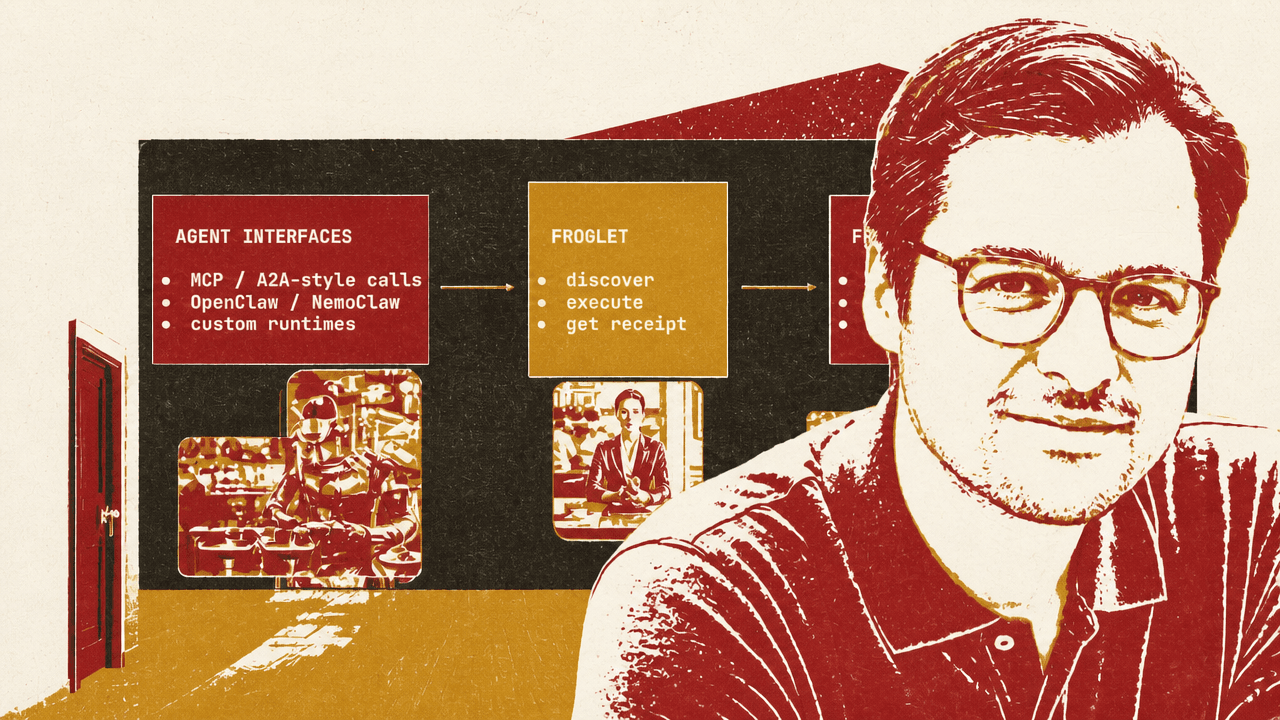
Scientific agents need an auditable supply chain
? armanas-povilionis argues that scientific research is among the most valuable targets for agentic automation, but that better tools alone will not make it autonomous. Research depends on collaboration among organizations holding data, compute, and specialized analysis services. For agents to work across those boundaries, he says, each step needs verifiable evidence: a record that establishes what was offered, agreed, executed, and returned.
Froglet is Alithea Bio’s proposed protocol for that setting. It is meant to let agents discover external resources, transact with providers, execute work, and receive signed receipts. The practical proposition is not that every participant adopt one software stack, but that they share an interface for dealing over services.
Povilionis compares the distinction to a kitchen. Better knives, pans, and ovens improve a cook’s local work. But scientific collaboration is closer to operating a high-end restaurant, where outcomes depend on suppliers, inputs, service levels, and the ability to deliver the same quality repeatedly. The constraint is not simply the tools inside one organization; it is coordination across the supply chain.
The challenge isn't local tools, it is aligning the entire supply chain.
That problem becomes more consequential as organizations give agents authority to spend. Povilionis says agents already receive primitive budgets as token limits. A broader version would allow them to manage budgets for discovering services, requesting data, negotiating execution, and paying for work across organizational boundaries. The agent then resembles an executive chef: locating suppliers, ordering inputs, coordinating work, and keeping a record of what occurred.
The receipt is Froglet’s evidence layer
Froglet reduces an interaction to a signed chain of artifacts: descriptor, offer, quote, deal, invoice bundle, and receipt. A new node generates a local keypair; its public key becomes its identity, while its private key signs the artifacts it produces. The displayed identity model requires no registration.
The artifacts are hash-linked. Povilionis says a change to part of the chain breaks it, because each stage is connected to the others. The protocol therefore treats evidence of the interaction as a first-class concern alongside discovery, trust, and settlement, rather than merely as a log retained by one provider.
| Artifact | Position in the signed chain |
|---|---|
| Descriptor | Provider’s service-description stage |
| Offer | Provider offer stage |
| Quote | Quoted interaction stage |
| Deal | Requester-signed commitment stage |
| Invoice bundle | Settlement-stage artifact |
| Receipt | Final signed artifact after execution |
And every time you execute anything with froglet, it uses your keys to sign on the chain.
The chain is intended to answer one of the questions shown in Froglet’s walkthrough: what a requester can audit after a provider elsewhere has executed work. Froglet itself is not an AI agent, Povilionis says. It is an interface built for agents to find data and services across organizational borders and make deals around them.
Marketplaces help agents find services; providers execute directly
Froglet uses homogeneous nodes: the same core node can act as requester, provider, or marketplace. A marketplace is a specialized Froglet service rather than a required intermediary. Providers publish signed feeds; the marketplace verifies signed descriptors, indexes bound offers, and returns provider URLs to requesters.
Once a requester finds a provider, the displayed flow moves to direct communication between those two parties: request a quote, receive a signed quote, sign a deal, execute the work, and receive a receipt. In the walkthrough’s execution flow, the marketplace is not shown mediating those exchanges.
That design is aimed at an environment where data, compute, and specialized analytics are distributed across organizations and often remain siloed. Povilionis says Froglet is intended to integrate with existing payment rails, agent harnesses, execution environments, and network transports rather than replace them. Participants do not need identical stacks; they need the same interface.
The protocol can be exposed through MCP, OpenClaw, NemoClaw, or raw HTTP. The displayed integrations include Claude Code, Cursor, Windsurf, local LLM agents, and other clients with network access. A local node is shown installing and starting from a single command. Separately, the supplied remote-demo prompt asks an agent to follow a hosted flow and report observed deal statuses, service IDs, results, receipt presence, and any mismatch between documentation and live behavior.
Settlement separates access protection from proof of success
Froglet’s displayed settlement model divides payment into a base fee and a success fee. Povilionis says the base payment protects providers from a flood of requests, framed on the slide as protection against DDoS. The success fee is intended to protect requesters from malicious providers by tying that portion of payment to successful completion.
The displayed sequence shows a base fee locked on acceptance, a held amount accepted on success, and a receipt settling the success fee. Povilionis’s broader premise is that payment rails can vary, while signed identity, deal state, workload execution, and the resulting evidence need to persist across hosts and organizations.
He contrasts this with closed scientific collaborations that become bespoke enterprise projects, taking years and costing millions before producing a first reusable workflow. Once an organization has decided a resource is shareable, he says, it should be able to expose that resource through Froglet. An agent could then discover it, understand the terms, request work, and receive a verifiable receipt.
The operational claim is narrow. Setting up Froglet, Povilionis says, costs “a few thousand tokens” and takes minutes. That does not remove the institutional decision to share data or services. It is meant to reduce the technical and transactional overhead after that decision has been made.