World’s Fair 2026 Recasts AI Engineering Around Deployment and Operations
Shawn Wang is pitching AI Engineer World’s Fair 2026 as more than a larger version of the group’s past conferences. In a video update, he argues that the San Francisco event is being redesigned around how AI engineering work is changing: a much larger expo floor, closer links between research and shipping teams, high-volume token operations, AI leadership practice, and vertical deployment in sectors such as finance and healthcare.
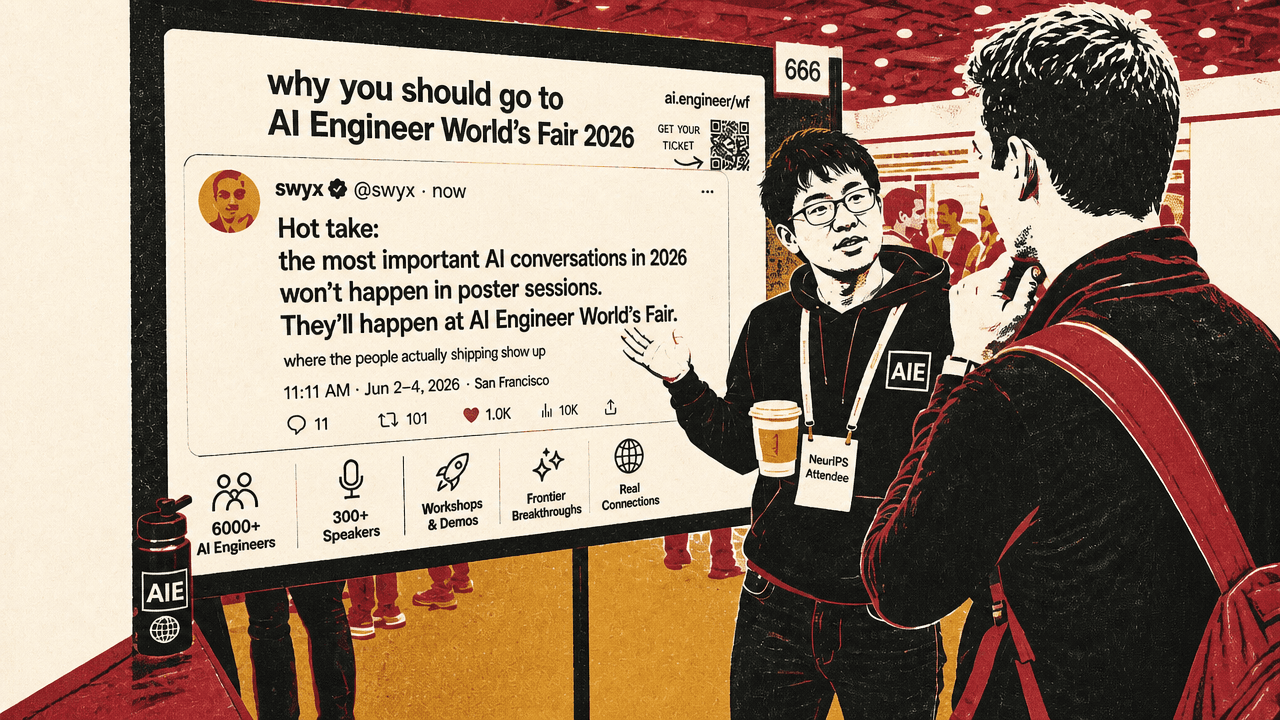
World’s Fair 2026 is being built as an operating map for AI engineering
AI Engineer World’s Fair 2026 is being pitched by Shawn Wang as the largest AI Engineer event so far, but the more consequential claim is about program design. Wang says the event is being reorganized around the parts of AI engineering that matter most in 2026: expo-floor density, research transfer, token-scale deployment, leadership operating models, and vertical adoption.
Wang says the event is being produced by a 15-person AI Engineer team and that the response to this year’s World’s Fair has been unusually positive. The update is aimed at both newcomers and returning AIE attendees because, in his telling, the 2026 version is not simply a bigger repeat of earlier gatherings.
The scale gives the organizers more room to specialize. Wang describes AIE less as a single conference agenda than as “a buffet” curated for different kinds of attendees, where one ticket covers a range of possible paths. The 2026 schedule is organized as 12 tracks per day and more than 400 sessions, with new or newly emphasized areas including autoresearch, memory and continual learning, AI in finance, voice and realtime AI, forward deployed engineering, computer use, healthcare, context engineering, inference, AI factories, post-training and RAG, and open source models.
The comparison to earlier AIE events is explicit. AI Engineer’s event-history slide lists prior events as sold out, including attendance and expo sponsorships, and positions the 2026 World’s Fair as the largest entry in that sequence.
| Event | Attendance | Speakers | Remote livestream attendees | YouTube views |
|---|---|---|---|---|
| World’s Fair 2024, San Francisco | 2,000+ | 150+ | 50,000+ | 800,000+ |
| AI Engineer Code Summit 2024, San Francisco | 800 | 50+ | 150,000+ | 1.5 million+ |
| World’s Fair 2025, San Francisco | 3,300+ | 200+ | 50,000+ | 4.5 million+ |
| AI Engineer Code Summit 2026, San Francisco | 800 | 50+ | 100,000+ | 2 million+ |
| World’s Fair 2026, San Francisco | 5,000+ | 300+ | 150,000+ | 3 million+ |
A YouTube Studio view reports 1,519,137 views for the AI Engineer channel so far in the selected year-to-date period, and Wang says the growth online still surprises him. He also points to the growth of regional AIE events, naming Melbourne, Miami, Singapore, and Paris.
The 2026 program is half continuity and half replacement. The team is bringing back roughly 50% evergreen topics, Wang says, and replacing the other half with topics that feel more relevant to 2026. Autoresearch is one example he gives of a track that “didn’t exist last year.” What had been a broad GPU track has been split into inference, post-training, and pre-training, with data quality treated as the pre-training theme. Memory and continual learning have been added, as have vertical tracks.
The schedule also extends further than some attendees may expect. Wang warns people not to fly out on July 2, saying the event has “a whole extra day of extra content” compared with last year and that some of the best material is on that final day.
The expo is treated as the main product, not the lobby
For Shawn Wang, the “dream” of the World’s Fair is that the talks are optional. The point is not that the talks lack value, but that the in-person advantage of the event is the hallway track: meeting people, asking questions, finding out what companies are actually shipping, and having conversations that do not fit into recorded sessions.
The expo is therefore treated as a core product. The 2026 expo is described as “4x larger,” with enough content to “spend an entire day catching up on everything great in AI Engineering.” The formula Wang gives is three days, four expo stages, and 150 sponsors. Those expo stages will host people talking about what they are launching, what they are shipping, and answering questions. Everything is recorded, he says, but the “real alpha” at AIE comes from what is said off record.
The whole point of a conference is to meet in person because everything’s recorded anyway.
The 2026 footprint is materially larger than last year’s. AI Engineer compares World’s Fair 2026 at Moscone West, with 150+ expo partners, against World’s Fair 2025 at the San Francisco Marriott Marquis, with 50+ expo partners. Another floor-plan comparison says the 2026 expo is three times bigger than last year’s and “built for the future of AI Engineering.” Wang says the team is familiar with Moscone West and likes hosting there because “everything happens in that building.”
The design of the expo has its own internal language. Wang points to named aisles on the Moscone West Level 1 floor plan: Attention Avenue, Backdrop Boulevard, Context Crescent, and Diffusion Drive. He calls Diffusion Drive “my baby.” He also tells attendees to look out for water stations and robots, adding that the event is starting to serve “things that are not human” as well.
The sponsor wall is part of the argument that the expo is meant to be comprehensive for AI engineering in 2026. A post from Marijan Cipcic on X calls the sponsor wall “hard not to be impressed” and describes the event as “arguably our industry’s version of the Super Bowl.” The visible sponsor list includes Amazon AGI Lab, Anthropic, Google DeepMind, Microsoft, OpenAI, Z.AI, AWS, Cloudflare, Databricks, Docker, IBM, LangChain, Meta, MongoDB, Oracle, Pinecone, Snowflake, Stripe, Supabase, Together AI, Vercel, Weights & Biases, and others.
Wang’s commercial argument is direct: for an Expo Explorer ticket, the cheapest entry-level tier he mentions, an attendee can wander the floor and “catch up on AI engineering for 2026.” That, he says, was always the difference between a World’s Fair and a summit.
The buyer value is aimed at operators, leaders, and high-volume AI users
AI leadership is treated by Shawn Wang as a distinct constituency: enterprises, CTOs, VPs of AI, and people managing AI engineers, hiring, recruiting, and setting up agentic organizations. The 2026 leadership program includes “Token Billionaires w/ Cerebras,” thematic focus, networking, and off-the-record discussions with McKinsey. Wang says Level 3 of Moscone West is essentially reserved for the leadership track, amounting to about half of the breakout-space floor area.
One of the new constructs is the “token billionaire” program. Wang points to Ryan Lopolito of OpenAI, who said in a prior AIE Europe talk that “we want everybody to be token billionaires.” Wang defines the threshold as spending on the order of a billion tokens per month. For some companies, he says, that is a low bar; some spend 10 trillion tokens per month. Qualifying attendees get access to a lounge that Wang compares to an Amex Platinum lounge, designed to create a different kind of conversation among people operating at significant AI usage levels.
The expected conversations are not all in one direction. Wang says there will be an even split between people trying to spend more, in smarter ways, and people trying to spend less. He jokingly refers to some of this as “heavily LLM psychosis,” but the operational tension is concrete: high-volume AI users are deciding when to increase token usage, when to reduce it, and what the right optimization frontier looks like. Wang says Alex Volkov from Weights & Biases calls this the “Z/L spectrum” after Mario Zechner, and that a related talk is coming at World’s Fair.
The thematic focus areas for AI leadership move away from generic executive networking. Previous versions were more undifferentiated, according to Wang: if someone was a leader or architect, the event would slot them near something “vaguely related.” In 2026, the leadership program is organized around daily themes people have specifically asked for.
One theme is “Show my Workflow,” where AI architects from Coda, Docker, and Hugging Face are described as opening up real production stacks, including agent runtimes, eval pipelines, and code reviews. Engineers from The Browser Company are described as showing how they automate their own jobs end to end. A second theme is “Tokenmaxxing,” with Microsoft, Jellyfish, and Arize AI weighing in on agents refactoring real codebases, the death of code review, and whether engineers should still read code. A third is “AI Factories,” covering how production AI systems get built and paid for, including token-spend FinOps and agent budgets, model routing across teams, and infrastructure arguments.
The networking layer is also being formalized. Wang says there will be a networking room where attendees can book meetings with speakers and other attendees through a new system the team is building. Separately, McKinsey will run daily off-the-record sessions where attendees can discuss what is happening inside their companies. The McKinsey program lists 60-minute sessions on tokenomics and the “agentic org of the future,” plus a third unannounced topic, alongside McKinsey’s “Moving away from code” work on how generative AI and other foundation models are rewriting software engineering.
The practical offer extends beyond the leadership track. A closing ticket slide lists the promo code “YOUTUBEPROMO” and “$38K+ in Sponsor Offers,” described as 27 sponsor offers available to all AI Engineer World’s Fair 2026 attendees from June 28 to July 2, 2026. The source description adds that regular bird tickets were expected to sell out by Monday and describes YOUTUBEPROMO as a YouTube-only discount for new tickets only. Wang says attendees get their money back in credits.
Research is being pulled into the same room as shipping work
“AIE for Researchers” is presented by Shawn Wang as a deliberate widening of the AI Engineer audience. He says the relationship between industry and research has become increasingly important, and that in his podcast conversations with labs and researchers, those practitioners often have a more fluid conception of research and engineering than outsiders assume. He cites a prior conversation with Greg Brockman at World’s Fair, where Brockman described people switching back and forth between research and engineering.
Wang’s stated ambition is to make AIE the industry counterpart to academic AI conferences such as ICML and NeurIPS. The 2026 event has a partnership with ACM around the ACM Conference on AI Agentic Systems, which ACM’s page describes as “the premier venue for rigorous, reproducible research on components, architectures, and systems of AI agents.” Wang says ACM has allowed AIE to do an “industry spotlight selection” of work relevant to this year’s audience, including some people who are also speaking again at AIE.
The model borrows from academic poster sessions, but Wang is interested in changing what counts as a shareable research artifact. He describes academic conferences as large industry-academic presentation markets where someone who has spent significant time on a topic can present their work, while attendees serendipitously discover unfamiliar ideas by walking past. He says some of his favorite NeurIPS experiences came from discovering work in exactly that way.
The underlying critique is of algorithmic feeds. Wang argues that feeds and recommendation systems are hyper-optimized for clickbait and for serving “10 of the same thing that you liked one time.” They do not have much taste, he says, because “the regression to the mean is super high.” A curated community of people who are “high effort” and “deeply involved” in the topic can produce a different kind of discovery.
That is the rationale for the poster sessions. It is also the rationale for “poaster” sessions — spelled with an “a.” Wang says the event put out a call for people to submit not only research posters but hot takes. If someone likes posting on Twitter and has a defensible take, AIE will print it out and put it “on the same level as a poster session,” where the person can defend the tweet.
The claim behind the joke is serious: Wang says there is something to learn not only from a published paper, but also from a blog post, a product, a talk, and “even a tweet.” AI Engineer’s call for submissions invites people to “present a research paper or a hot take” as part of the official Posters & Poasters track.
The vertical tracks follow where AI is being deployed
AIE is “betting hard on AI verticals” in 2026, Shawn Wang says, in contrast to the more horizontal expansions of the prior year. He gives design engineering and product management as examples of tracks that were broad and still worthwhile, but says much of the current year’s AI deployment is happening in high-value verticals.
The selected verticals are forward deployed engineering, agentic commerce, healthcare, finance, and go-to-market. Wang says this direction is partly inspired by Christopher Lovejoy, a prior AIE speaker whose talk was highlighted on the AI Engineer YouTube page under the title “Make your LLM app a Domain Expert: How to Build an Expert System.”
The vertical descriptions show how AIE is defining the tracks. Forward deployed engineering is framed around engineers embedding with customers, wiring custom integrations, debugging production systems, and learning lessons such as how to stop shipping low-quality RL environments. Agentic commerce is about agents that hold wallets and authorize payments “at machine speed,” with machine-to-machine commerce rails, spending controls, and intent-driven UX as core concerns. Healthcare is about patient-facing systems, ambient clinical documentation, multi-agent care, voice at scale, co-clinician models, and the guardrails and regulatory rigor those systems require. Go-to-market is described as covering how sales organizations are being rebuilt.
Finance receives separate emphasis. Wang calls AI in finance “the special one that takes precedence above all of them,” because it is the big bet for AI Engineer New York. He pre-announces AI Engineer New York for October 12–14, 2026, describing it as the third New York conference but the first focused entirely on finance. The sponsorship prospectus presents it as “Where AI Engineering Meets Financial Services,” with 1.5 million unique website hits annually, 1,000+ AI architects and technical leaders, 100+ top industry speakers, and 150,000+ remote livestream attendees.
Wang’s reasoning is personal and sectoral. He says he comes from a finance background, having been a sell-side trader and a buy-side hedge fund person. If there is a vertical after code that is most likely and closest to code for takeoff, he says, it is finance, followed closely by healthcare, law, forward deployed engineering, and go-to-market. The broader claim is that understanding verticals is now substantial enough to become its own conference format, not just a set of examples inside a general AI engineering event.
Side events are part of the event architecture
There are more than 40 side events around World’s Fair, according to Shawn Wang, and the website listed 41 at the time of recording. He directs attendees to ai.engineer/wf and the side-events page, where companies and individuals hosting events around the conference can be listed. The stated purpose is straightforward: continue conversations outside the main day of programming.
One side event Wang names is the World Cup. He says Team USA playing during the event is now confirmed, and while no single venue can accommodate 6,000 people, attendees should join one of the watch gatherings, “watch it with nerds and talk about AI.” A post from Fabrizio Romano shown in the update says the United States had advanced to the FIFA World Cup Round of 32.
A more operational addition is NEO, or New Engineer Orientation. Wang says the idea came from feedback after AI Engineer Europe. It is for people attending alone, people completely new to the event, and returning attendees who are open to networking and helping others. World’s Fair is otherwise designed for teams, he says: with 10 to 12 simultaneous tracks, a team can divide and conquer, assign one person per track, and regroup at the end of the day in a “map reduce of content.” NEO is meant to give solo attendees a way into that kind of experience.
The Luma listing for “AI Engineer World’s Fair - New Engineer Orientation (IRL)” gives Tuesday, Jun 28, 6:00 PM to 8:00 PM at Moscone West in San Francisco. Wang says 300 people had signed up so far, and he expects it to reach 1,000. He also says the team needs help because many people will have similar questions. They have a chatbot, he says, but “no one’s going to use it” because people want to talk to humans.
That comment becomes a small thesis about the event itself. Even in a community that believes in AI and likes AI, Wang says, people still want to talk to humans. “That’s why we’re all here.”
The side-event program also includes AI Engineer Kids Day, organized by Neoforge. Wang says he was not involved, but he highlights it because he thinks it is cool. His description is specific: it is not about becoming a better parent; it is about bringing a child and getting them interested. The Luma page lists “AI Engineer Kids Day” for Monday, Jun 29, 9:00 AM to 1:00 PM at Digital Jungle SF in San Francisco.
Wang closes by describing AIE as a village rather than a production owned by one person. He says he cannot take credit for how well AIE has gone because people have decided to pitch in and make the community meaningful. The reason he gives is adversarial: “there’s so much slop out there,” and AIE is still in a “war on slop.” His final practical instruction is simple: come to the event, and do not travel outside the United States during the week of July 2.